Every marketer wants to know what dies next.
Will AI kill websites?
Will search disappear?
Will social media collapse under the weight of its own nonsense?
Will email finally die after being declared dead every six months since roughly the invention of the fax machine?
I don’t buy it.
Not because technology doesn’t change things. Of course it does. You’d have to be aggressively asleep not to see that.
AI is changing search.
Social has changed news.
Streaming changed television.
The internet changed almost everything.
But here’s the bit we keep stuffing up.
Technology changes faster than people change their habits.
That’s the paradox.
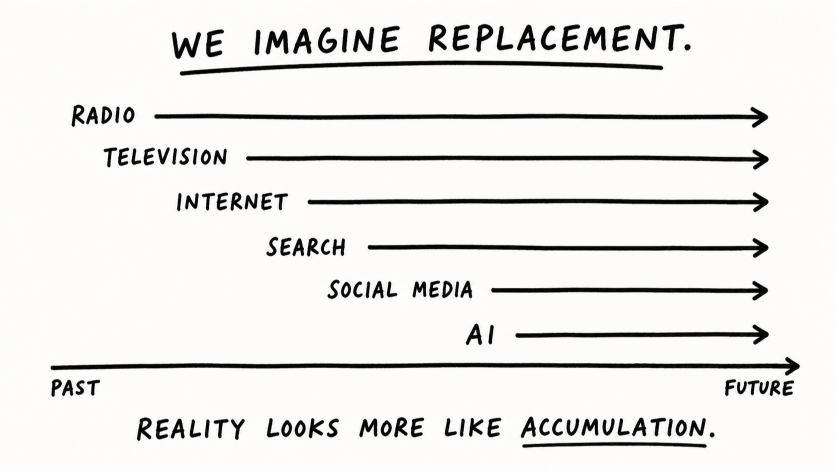
We imagine replacement.
Reality looks more like accumulation.
Radio didn’t disappear when television arrived.
Television didn’t disappear when the internet arrived.
Websites didn’t disappear when social media arrived.
Search didn’t disappear when AI arrived.
What actually happens is much messier.
The new thing arrives. The old thing changes role. Different groups adopt different behaviours at different speeds. Then marketers stand in the middle of the mess pretending they can predict the future with a Canva slide and a graph pointing up and to the right.
Adorable.
So the useful question is not what dies next.
It is this: what job does each channel do once the new thing arrives?
The replacement myth
Marketing loves a death narrative.
“TV is dead.”
“Radio is dead.”
“SEO is dead.”
“Websites are dead.”
“Email is dead.”
“Organic social is dead.”
Most of these predictions are less like strategy and more like a bloke at the pub confidently explaining cryptocurrency after two beers and one YouTube video.
The problem is not that these predictions are always completely wrong.
The problem is they are too clean.
They assume one behaviour replaces another.
But humans do not behave like software updates.
We don’t all wake up on a Tuesday and go:
“Right, that’s it. Version 4.7 of my media consumption habits has installed. I no longer use search. I only ask robots now.”
That’s not how life works.
People are shaped by age, income, confidence, culture, work, convenience, memory, trust and plain old stubbornness.
Some people change quickly.
Some change slowly.
Some never change at all.
That is not a fringe observation. That is the normal state of human behaviour.
Same year. Different worlds.
Look at television.
There are adults alive today who have probably never tuned a television through an antenna.
To them, television is an app.
Netflix, YouTube, Disney+, TikTok, whatever. It is all just video. It lives inside a screen and appears when demanded, like a digital butler with emotional problems.
Then there are older Australians whose media habits are still built around free-to-air TV.
They turn it on.
They watch what is scheduled.
They trust the newsreader.
They don’t need seven streaming subscriptions, three passwords, a software update and a blood sacrifice just to watch a bloody show.
Same year.
Different worlds.
The data backs this up.
In 2025, ACMA found that 91% of Australian adults used an online service to watch video content in a given week. Streaming is not some niche behaviour anymore. It is mainstream. But traditional free-to-air TV, excluding catch-up, was still watched by 52% of adults in 2025. That figure even increased slightly after years of decline. So yes, streaming won. But free-to-air did not vanish. It became one layer in a larger behaviour stack.
That matters.
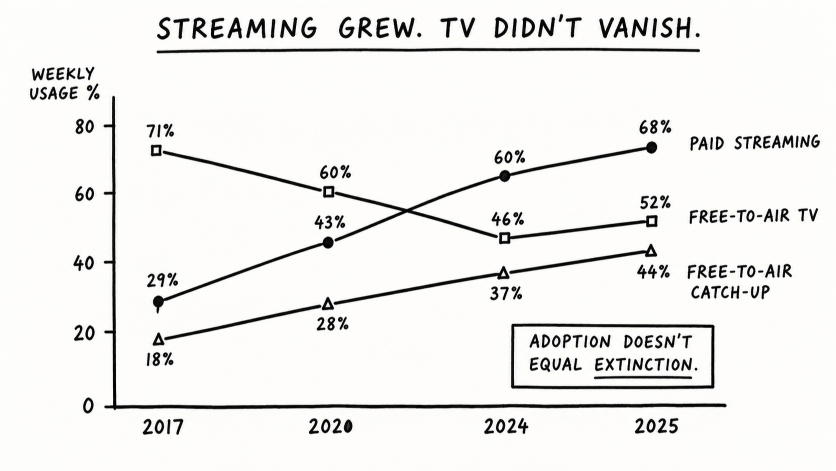
Because marketers keep planning as though adoption equals extinction.
It doesn’t.
Adoption usually means fragmentation.
Audio tells the same story
Music streaming is huge.
Podcasts are everywhere.
Bluetooth speakers are in kitchens, cars, bathrooms and probably someone’s fridge by now because apparently everything needs Wi-Fi.
But radio is still here.
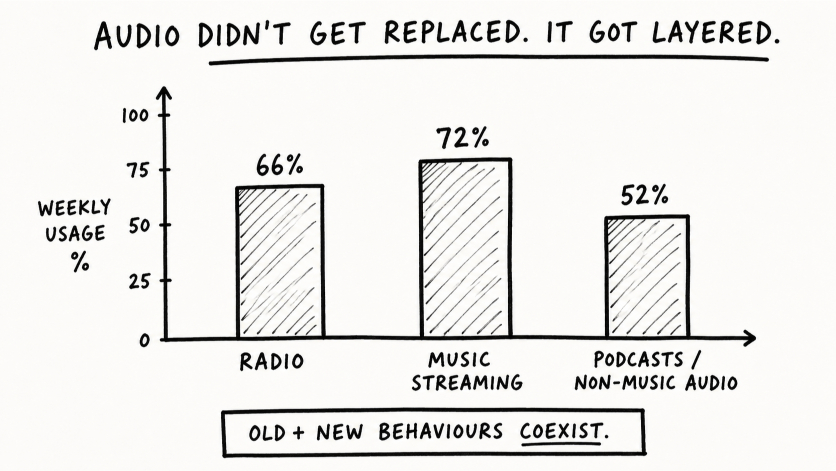
ACMA reported that 72% of Australian adults used online streaming to listen to music in 2025, while nearly two-thirds still listened to radio in the previous week.
Again, not replacement.
Layering.
New behaviours arrive. Old behaviours shrink, shift or become more specific.
Radio becomes the car habit.
TV becomes the sport habit.
Websites become the proof layer.
Search becomes the intent layer.
Social becomes the discovery and identity layer.
AI becomes the shortcut layer.
None of these things exist in isolation. They overlap.
And that overlap is where most marketing strategy gets painfully sloppy.
News is now fragmented beyond parody
News consumption might be the clearest example of this entire problem.
The University of Canberra’s Digital News Report: Australia 2025 found that television remained the most popular main source of news at 37%. But for the first time in the eleven years of the Australian survey, social media overtook online news websites as a main source: 26% for social media versus 23% for online news.
That is the whole point in one neat little headache.
Television is still number one.
Social media has overtaken online news.
Online news is still significant.
People are also getting news from influencers, creators, podcasts, group chats, screenshots, rage bait headlines and that one uncle who thinks Facebook comments are peer-reviewed research.
So what is “the channel”?
There isn’t one.
There are behaviours.
Some people sit down for the 6pm news.
Some scroll TikTok.
Some search Google.
Some ask ChatGPT.
Some read the ABC.
Some read The Guardian.
Some watch Sky.
Some get their political worldview from a meme made by someone with the design skills of a hostage note.
That’s the real media environment.
Messy. Layered. Contradictory.
Very human.
AI is real. The panic is optional.
Now let’s talk about the shiny robot in the room.
AI is absolutely changing behaviour.
Anyone pretending otherwise is lying to themselves, or selling a very tired SEO webinar from 2016.
Roy Morgan reported in June 2026 that 13.6 million Australians aged 14 and over — 58% of that population — used AI tools in an average four-week period during the March quarter of 2026. ChatGPT was the clear leader, used by 10.5 million Australians, or 45%.
That is not small.
That is not fringe.
That is a behavioural shift.
But it is not evenly distributed.
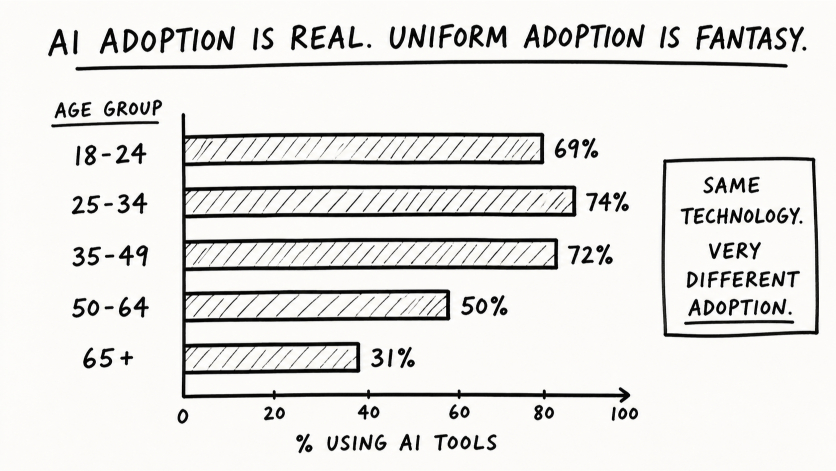
Roy Morgan also found that AI usage was highest among Australians aged 25–34 at 74%, followed by 35–49 at 72%. Usage dropped to 50% among those aged 50–64, and 31% among people aged 65 and over.
The Australian Digital Inclusion Index found a similar divide: 46% of Australians reported recently using GenAI, while 69% of 18–34-year-olds had used it. Same technology. Very different uptake.
So yes, AI adoption is moving fast.
But it is still layered by age, confidence, access, job type, education and need.
That means the future of marketing will not be “AI replaces everything”.
It will be:
Some customers use AI.
Some still search.
Some use both.
Some ask their friends.
Some go straight to a brand.
Some click ads.
Some avoid ads like they’re dodging a dodgy kebab at 2am.
Some want the answer.
Some want the research.
Some want reassurance.
Some want to compare ten options and then buy the one their partner told them to buy in the first place.
That’s the job now.
Not predicting one behaviour.
Understanding the layers.
Websites are not dead. Weak websites are.
This is where I think the “websites are dead” argument falls over.
Could AI reduce some website visits?
Yes.
Could AI answer more questions before users click?
Yes.
Could some low-value informational content get swallowed alive?
Absolutely.
If your entire website exists to answer generic questions with generic content, then yes, the robot may eat your lunch. To be fair, it was probably a pretty bland lunch.
But that does not mean websites become redundant.
It means weak websites become exposed.
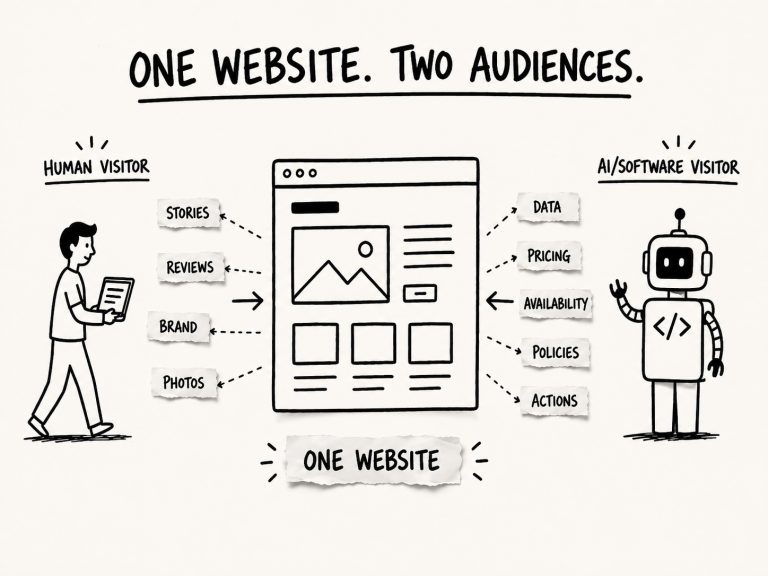
A website is no longer just a digital brochure.
It is the source of truth.
The conversion point.
The trust layer.
The structured content layer.
The brand proof.
It is the place where customers, search engines, AI tools, journalists and partners should be able to understand what you do, who it is for, and why anyone should care.
Search is also not dead.
StatCounter showed Google still held 88.04% search engine market share in Australia in June 2026, with Bing at 9%.
That does not mean search is safe forever.
It does not mean behaviour is unchanged.
But it does make “search is dead” sound like something said by a person standing suspiciously close to a sales deck.
At the same time, AI referrals are growing fast.
Adobe reported that traffic from AI sources to US travel sites grew 194% year-on-year in May 2026 and was up 2,215% since October 2024, when Adobe began tracking AI traffic data. Those AI-referred visitors were also 21% more engaged, spent 70% longer on site and had 41% lower bounce rates than non-AI sources.
That is important.
AI is becoming a discovery layer.
But notice where the traffic goes.
To websites.
That’s the funny bit everyone keeps skipping.
AI may change how people discover you.
But once they want depth, reassurance, pricing, proof, availability, booking, comparison or legitimacy, they still need somewhere to land.
That place had better not be a slow, thin, confusing website with a hero banner that says “Creating unforgettable experiences” like every other brand that lost a fight with a mood board.
The real issue is proliferation
So where should marketers focus?
That is the actual question.
Because the hard part is not that channels are disappearing.
The hard part is that there are too many of them.
Search.
Paid search.
Organic social.
Paid social.
Email.
YouTube.
TikTok.
LinkedIn.
Programmatic.
Influencers.
PR.
Podcasts.
Communities.
Marketplaces.
Review platforms.
AI assistants.
Direct traffic.
Apps.
Offline.
Word of mouth.
SMS.
Content.
Partnerships.
Events.
And somewhere in the middle of all that, a marketing team of six people is being asked why they haven’t “tested everything”.
Beautiful.
Nothing says strategic clarity like fifteen channels, three dashboards and a stakeholder asking if we should “just do a viral”.
This is why the answer cannot be “do everything”.
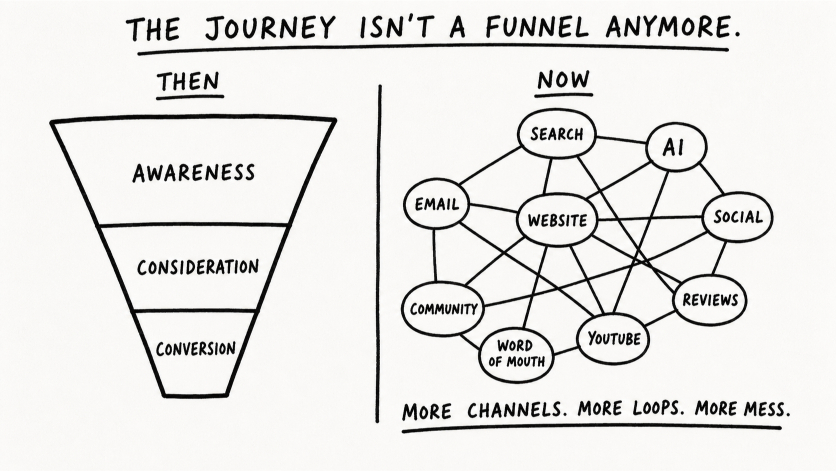
That is not strategy.
That is panic wearing a lanyard.
The better answer is to build a marketing system that understands the layers.
A better model: layered marketing
The question should not be:
“What channel wins?”
The question should be:
“What role does each channel play?”
Because once you think in roles, the mess starts to make sense.
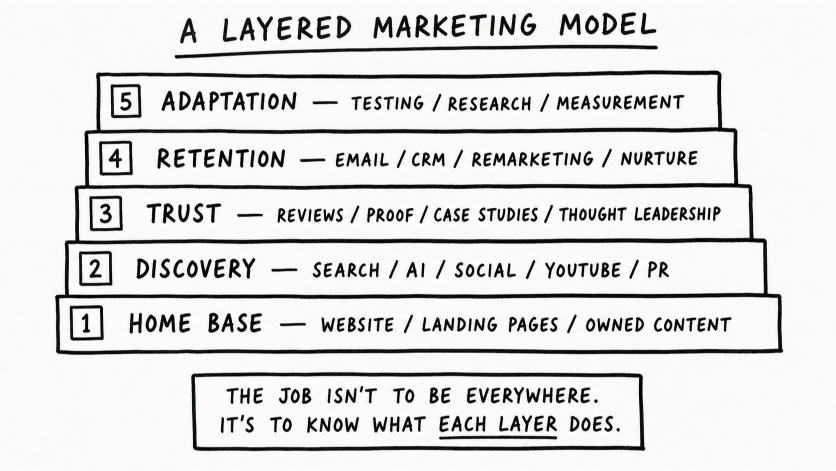
1. Home base: where control lives
This is your website: not because websites are fashionable, but because you need somewhere you control.
Search algorithms change.
Social platforms throttle reach.
AI tools summarise without sending traffic.
Ad costs rise.
Platforms change rules.
Your website is still one of the few places where you control the message, shape the path, capture demand and build something that does not vanish because an algorithm sneezed.
But it needs to earn that role.
A modern website needs:
- clear product and service pages
- useful content that actually helps
- strong internal linking
- structured data
- fast performance
- proof, reviews and case studies
- FAQs that answer real questions
- conversion paths that don’t feel like a tax form
Your website is not dead.
But the lazy brochure site is.
And honestly, good riddance.
2. Discovery: where people first notice you
This is where people first notice you: search, AI, social, YouTube, PR, partnerships and creators all doing discovery work at once. Because apparently one headache was not enough.
The mistake is treating these as separate worlds.
They increasingly feed each other.
A strong blog can support search.
The same ideas can become LinkedIn posts.
The same concepts can become YouTube scripts.
The same structured content can help AI systems understand your brand.
The same FAQs can support customer service, paid search landing pages and email nurture.
The idea is not to create more content.
It is to create better raw material, then stop pretending every channel needs to be fed from scratch.
Wild concept, I know.
3. Trust: where attention becomes belief
Attention is cheap.
Trust is expensive.
This is where most brands are weak.
They can get in front of people.
They just can’t make people care.
Trust comes from proof. A point of view. Specific examples. Clear language. Humans who sound like they have actually done the thing, not just downloaded the template.
Not another values page saying “integrity, innovation and excellence” like it was generated by a committee trapped in an airport lounge.
If AI increases the volume of generic content, then trust becomes more valuable, not less.
The brands that win will sound like they are run by people who know what they are talking about.
Revolutionary stuff.
4. Retention: where money is quietly made
This is email, CRM, remarketing, lifecycle journeys and customer communication: where money is quietly made while everyone else argues about whether TikTok has peaked.
Not sexy.
Still powerful.
Because while everyone is chasing new attention, existing customers are sitting there being ignored like the middle child of the marketing plan.
Retention matters more in a fragmented environment because acquisition is getting harder.
If someone has already bought from you, subscribed, enquired, downloaded, stayed, booked or engaged, that relationship is worth building.
But again, not with bland automation that sounds like a toaster wrote it.
Useful reminders. Post-purchase support. Relevant offers. Good timing. Clear next steps.
5. Adaptation: where strategy stays alive
This is the part nobody wants to talk about because it sounds less exciting than “AI transformation”.
Testing, measurement, customer research, channel experiments, message testing, creative iteration and attribution sanity checks. In other words, knowing what is actually happening before declaring a new strategy.
The brands that survive this period will not be the ones with the boldest prediction.
They will be the ones with the best learning loops.
Because nobody knows exactly how this shakes out.
Anyone saying they do is either guessing, selling or wearing a suspiciously shiny headset at a conference.
Planning beyond two years is hard now
This is the awkward truth.
Planning more than two years out in marketing is starting to feel like packing for a holiday without knowing the country, the weather, or whether pants will still exist.
Not impossible.
Harder.
The tools are changing quickly.
Customer expectations are changing.
AI behaviour is changing.
Search results are changing.
Platforms are changing.
Measurement is getting murkier.
Privacy rules are tightening.
Internal teams are stretched.
Budgets are under pressure.
And yet, despite all that, the basic human stuff remains stubbornly familiar.
People still want answers.
People still want shortcuts.
People still want trust.
People still want proof.
People still ask friends.
People still compare.
People still procrastinate.
People still buy emotionally and justify rationally.
People still ignore most marketing because most marketing deserves to be ignored.
That is why the smart move is not to bet the farm on a single prediction.
The smart move is to build a marketing system that can absorb change.
Strong owned assets.
Clear positioning.
Useful content.
Search visibility.
AI-readable information.
Distinctive creative.
Email and CRM foundations.
Customer insight.
Measurement that is directionally useful, not religiously worshipped.
A team that can learn quickly without chasing every shiny object like a golden retriever in a tech expo.
The role of marketers is changing
Marketers used to be able to think in channels.
Now we need to think in behaviours.
Not “Should we be on TikTok?”
But “Does our audience use short-form video to discover, validate or be entertained in this category?”
Not “Is SEO dead?”
But “How do people look for answers, compare options and build confidence before they buy?”
Not “Will AI kill websites?”
But “How do AI systems understand, summarise and recommend our brand — and what happens when users arrive?”
Not “Should we send more emails?”
But “What does the customer actually need to hear after they first show interest?”
Channels are just containers.
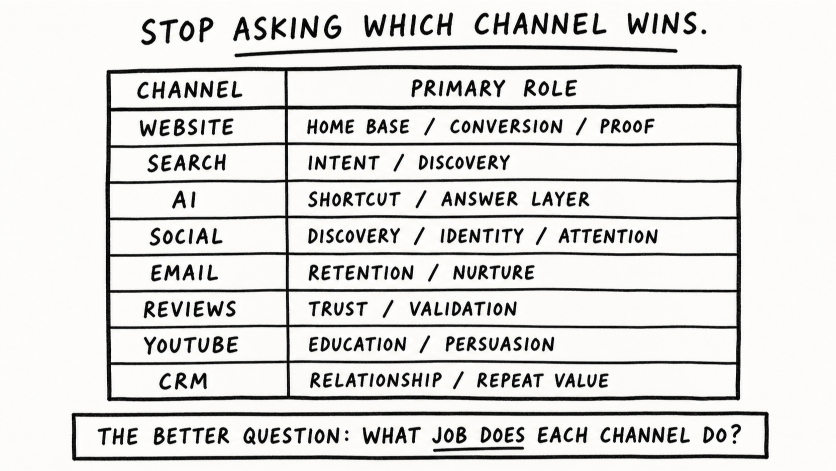
Behaviour is the thing.
And behaviour changes slowly, unevenly and often irrationally.
Annoying, yes.
But also useful.
Because it means the future is not just about technology.
It is about memory.
Habit.
Trust.
Familiarity.
Convenience.
Identity.
Confidence.
Fear.
Status.
In other words, all the messy human stuff marketers should have been paying attention to all along.
The old thing does not die. It changes job.
That is the line I keep coming back to: the old thing does not die. It changes job.
Radio becomes the commute habit.
Free-to-air TV becomes the routine, sport and older-audience habit.
Websites become the proof and conversion layer.
Search becomes one answer engine among many.
Social becomes entertainment, identity, news, commerce, outrage and self-promotion in one cursed slot machine.
AI is not replacing all of it. It is joining it.
And when a new layer arrives, the question is not “what dies?”
The question is: “What does everything become now?”
That is where the strategic thinking lives.
So where should marketing focus?
Focus on the things that survive channel shifts.
Know your audience better than the platform does.
Build owned assets you can control.
Make your content useful enough to be found, cited, shared and remembered.
Structure your information so both humans and machines can understand it.
Create a point of view sharp enough that people know it came from you.
Invest in trust.
Strengthen retention.
Test new behaviours without torching the fundamentals.
And stop pretending the future arrives evenly.
It doesn’t.
It arrives in layers.
One customer is asking ChatGPT.
Another is Googling.
Another is watching YouTube reviews.
Another is reading Reddit.
Another is opening your email.
Another is asking their mate.
Another is still watching free-to-air TV and has never logged into Netflix.
Same market.
Different worlds.
That is the job now.
Not predicting the one channel that wins.
Building a marketing system that works across the mess.
Technology moves in releases.
Humans move in habits.
And marketers keep confusing one for the other.
Sources
• ACMA: Streaming remains Australia’s favourite way to watch or listen (5 March 2026) — video, free-to-air TV, radio and music streaming figures.
• University of Canberra: Digital News Report: Australia 2025 (17 June 2025) — television, social media and online news as main news sources.
• Roy Morgan: 13.6 million Australians now use AI tools (2 June 2026) — AI usage, ChatGPT usage and age breakdowns.
• Australian Digital Inclusion Index: GenAI use surges (3 November 2025) — recent GenAI use and demographic differences.