Festivals aren’t dying.
Lazy festivals are.
That’s the bit people keep missing.
Every time another festival cancels, collapses, or quietly disappears like a bloke who said he’d definitely transfer you for the Airbnb, someone declares the whole festival model dead.
It isn’t.
People still want live music. They still want crowds. They still want the stupid little wristband they refuse to cut off for three weeks because apparently hygiene is less important than personality.
What they don’t want is to pay a small fortune to stand in a paddock watching a recycled line-up while eating chips from a cardboard tray like a defeated seagull.
That’s the shift.
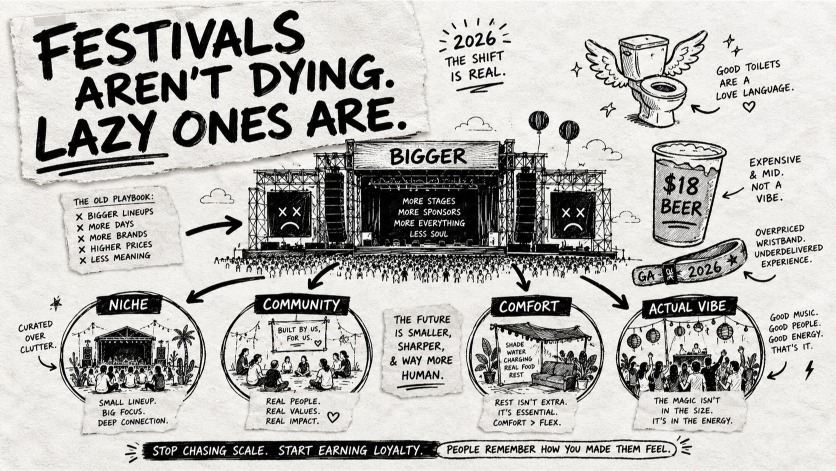
The future of music festivals in 2026 is not bigger stages, bigger headliners and bigger ticket prices.
It’s sharper.
More specific.
More human.
And weirdly, more practical.
Because fans are not stupid. They know the real cost now.
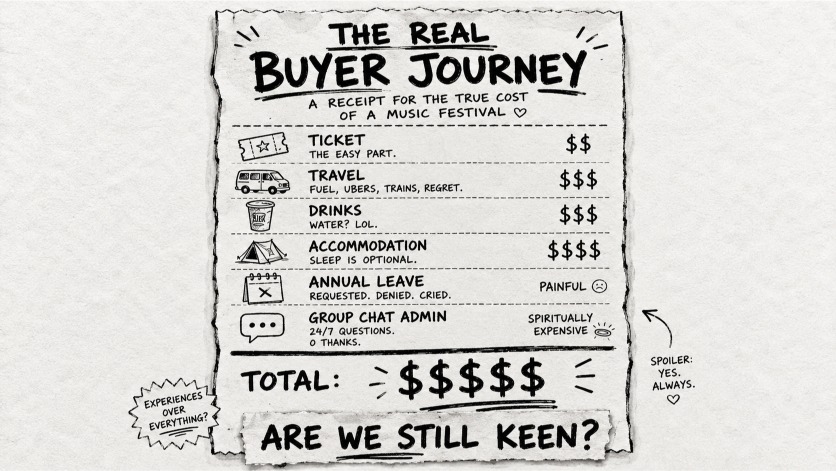
Ticket. Travel. Food. Drinks. Accommodation. Annual leave. The emotional cost of trying to organise six mates who all say keen but only one actually buys a ticket.
That’s the real buyer journey.
Not ‘Do I like the line-up?’
More like: is this worth the financial and logistical nonsense required to attend?
That’s the question every festival has to answer in 2026.
The festival industry doesn’t have a demand problem. It has a meaning problem.
Let’s kill the lazy take first.
Live music is not dead.
Live Nation reported first-quarter 2026 revenue of $3.8 billion, up 12%, with concert fan attendance up 7%. It also said more than 107 million tickets had already been sold for 2026 Live Nation concerts by the end of April, up 11% across stadiums, arenas, amphitheatres and festivals. [Live Nation]
So no, the public has not suddenly decided to stay home forever and develop a deep emotional bond with Uber Eats.
People are still buying tickets.
They are just getting pickier.
And fair enough.
The world is expensive. Everyone’s inbox is screaming. Every brand thinks it’s a lifestyle movement. And every event wants to act like it’s unmissable.
Most aren’t.
That’s the problem.
A festival cannot survive in 2026 just because it exists.
It needs a reason to exist.
Not a mission statement. God help us.
A real reason.
A clear audience. A clear feeling. A clear identity. A clear answer to the question: why this and not something else?
Because ‘we booked some acts and hired a field’ is not a strategy.
It’s a weather-dependent invoice.
Australia is the warning sign
Australia is a perfect case study because we love live music, but the economics are getting ugly.
Creative Australia’s 2025 live music research found Australians still value live music, especially for emotional and social connection, but rising costs across tickets, travel, food and drinks are a barrier. It also found audiences are buying tickets later and cutting back on bar spend, which makes the old festival business model much harder to rely on. [Creative Australia]
That’s the squeeze.
Fans still want to go. Organisers still need early money. Costs keep climbing. Everyone is waiting longer. And the festival is sitting there trying to build a city in a field before the cash is guaranteed.
Brilliant system.
No obvious flaws there.
Bluesfest made this painfully real. I have written separately about the inside view of the Bluesfest collapse, and in March 2026 The Guardian reported that the Byron Bay festival was cancelled after its organiser went into liquidation, owing ticket holders more than $23 million. [The Guardian]
That story matters because Bluesfest wasn’t some random backyard event with a borrowed PA and a dream.
It was an institution.
And when institutions struggle, the industry should stop pretending everything is fine.
This is not about whether people like music.
They do.
It’s about whether the model still works when fans delay decisions, costs rise, and one bad sales window can send the whole thing sideways.
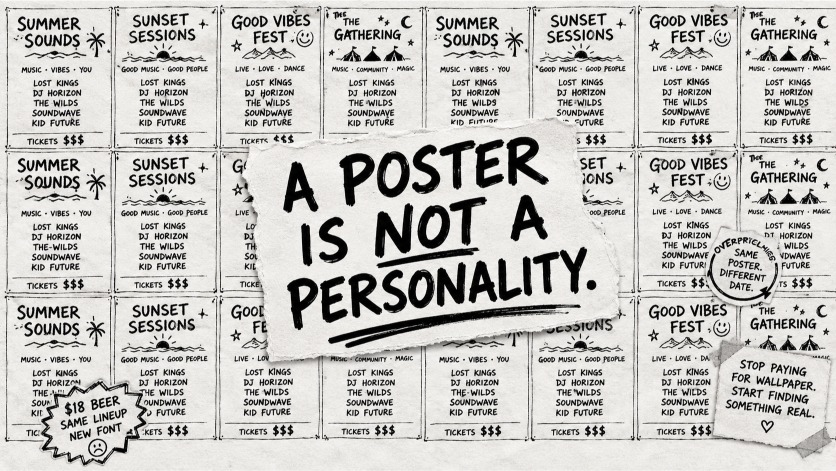
Generic festivals are expensive wallpaper
Here’s the hard truth.
Trying to appeal to everyone is how festivals become expensive wallpaper.
Safe. Broad. Forgettable. Nice enough. Dead behind the eyes.
The festivals that win in 2026 won’t be the ones trying to please everyone.
They’ll be the ones brave enough to piss off the wrong people so the right people feel at home.
That’s what niche festivals understand.
A metal festival knows who it is for. A country festival knows who it is for. A queer pop event knows who it is for. A vinyl night knows who it is for. A nostalgia-heavy 2000s festival absolutely knows who it is for: adults with lower backs, credit cards and unresolved feelings about MySpace.
Specificity sells because people don’t just buy events.
They buy identity.
They buy the feeling of walking in and thinking: yep, these are my people.
That is much more powerful than a line-up poster full of names arranged by font size like a hostage note from the music industry.
A poster is not a personality.
A festival needs a world.
A language. A ritual. A crowd. A look. A story. A reason people feel stupid for missing it.
That’s what makes a festival matter.
Not just the acts.
The world around the acts.
The line-up is not enough anymore
There was a time when festival marketing was basically:
Drop the line-up. Make the headliner huge. Wait for ticket sales. Act surprised when people complain about the toilets.
That still works for some major events.
But it’s getting less reliable.
Ticketmaster’s UK festival trend reporting found almost one in five festivalgoers now buys before any acts are announced, triple the number in 2019. The report also found price and value were the biggest ticket-buying motivators, followed by location, travel and schedule. [Ticketmaster report summary]
That tells you something important.
The festival brand matters. The atmosphere matters. The trust matters.
People are not just asking, ‘Who’s playing?’
They are asking: will this be worth it? Will this be easy enough? Will this feel like me? Will I regret spending this money? Will I be able to leave without being trapped in a car park until the next census?
The line-up gets attention.
The experience gets repeat customers.
That difference matters.
Because anyone can announce a line-up.
Not everyone can build trust.
Social media is the front door now
Festival discovery used to happen through posters, radio, street press, email lists and that one mate who knew about gigs before everyone else and made it his whole personality.
Now it happens in fragments.
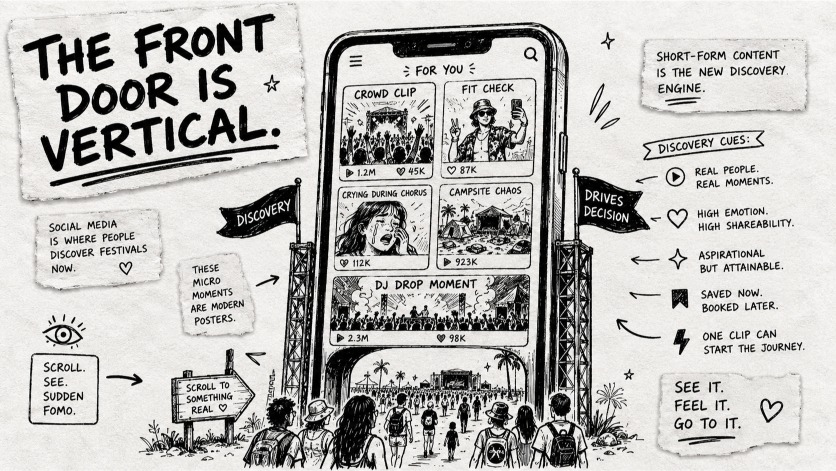
A 12-second TikTok. A crowd clip. A fit check. A campsite video. A stranger sobbing during a chorus. A DJ playing the exact song that makes 4,000 people lose their minds at once.
That’s the front door.
Ticketmaster’s festival report found 25% of festivalgoers discover new festivals through social platforms, while 33% say documenting the weekend is part of the ritual. Fans also want better Wi-Fi, more charging points and better lighting for night content. [Ticketmaster report summary]
Some organisers will roll their eyes at that.
‘People should just enjoy the moment.’
Sure.
Lovely thought.
Also completely detached from how humans work.
People have always documented identity.
Ticket stubs. Band shirts. Wristbands. Disposable cameras. Blurry photos from the mosh pit where everyone looked like they were being abducted.
Now it’s vertical video.
Same impulse. Different rectangle.
The smart festival doesn’t fight this.
It designs for it without turning the place into an influencer petting zoo.
Show the crowd. Show the ritual. Show the odd corners. Show the little moments. Show the thing that makes someone think, ‘Damn, I should be there.’
Don’t just promote the event.
Let people feel the event before they buy.
Comfort is not soft. Comfort sells.
There’s an old festival myth that discomfort equals authenticity.
Mud. Queues. Heat. Toilets that look like a crime scene. A $7 bottle of water handed to you by someone who has spiritually left their body.
Apparently this builds character.
No thanks.
I have enough character. I’d like shade.
Comfort is not the enemy of a good festival.
Comfort is what allows people to enjoy the bloody thing.
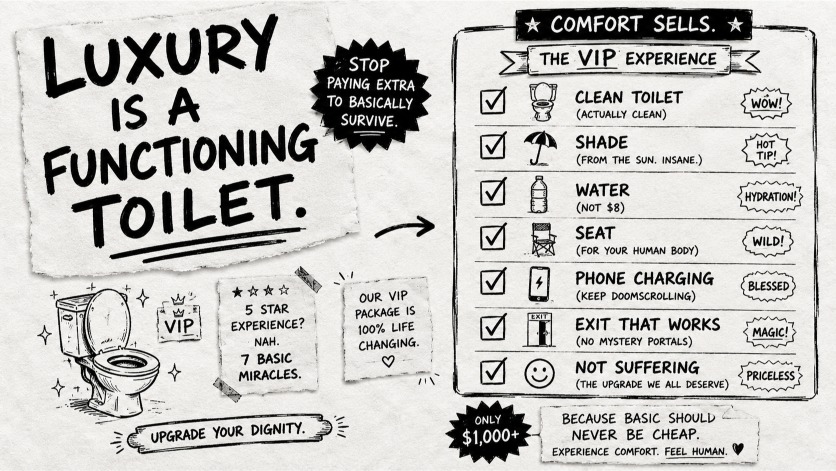
Ticketmaster’s reporting found nearly 50% of VIP upgrades are driven by better toilets, showers and rest areas. Faster entry, shorter queues and calmer spaces were also a major upgrade driver. [Ticketmaster report summary]
That is one of the least sexy but most important insights in the whole industry.
People will pay not to suffer.
Wild concept.
And this is where a lot of festivals get it backwards. They spend heavily on the thing people see from a distance, then neglect the thing people feel all day.
The stage matters.
But so does water. So does shade. So does signage. So does seating. So does crowd flow. So does transport. So does not making people queue for 40 minutes to use a toilet that should be tried at The Hague.
The boring stuff is not boring to the person paying.
The boring stuff is the product.
Get it wrong and nobody cares how good the lighting rig was.
They remember the pain.
Sustainability can’t just be three bins and a paragraph
Festival sustainability used to mean a reusable cup, a recycling station, and a paragraph on the website that sounded like it had been written by a committee trapped in a Google Doc.
That won’t cut it now.
Ticketmaster’s festival research found 67% of fans say sustainability impacts ticket choice, nearly 80% see waste reduction as a priority, and 66% want low-carbon travel options. [Ticketmaster report summary]
Now, let’s be honest.
Most punters are not reading your sustainability policy like it’s scripture.
They’re not sitting at home thinking, ‘Before I see the headliner, I must inspect the carbon plan.’
But they do notice bullshit.
They notice when a festival bangs on about values and leaves the site looking like a plastic apocalypse.
They notice when there is no clear transport plan.
They notice when every eco-friendly claim is followed by a mountain of disposable branded junk nobody asked for.
The future is practical sustainability.
Less halo polishing.
More useful systems.
Better waste. Better transport. More refill points. Less landfill merch. Smarter suppliers. Clearer communication.
Nobody expects perfection.
They do expect you not to insult their intelligence.
Pop culture is moving offline again
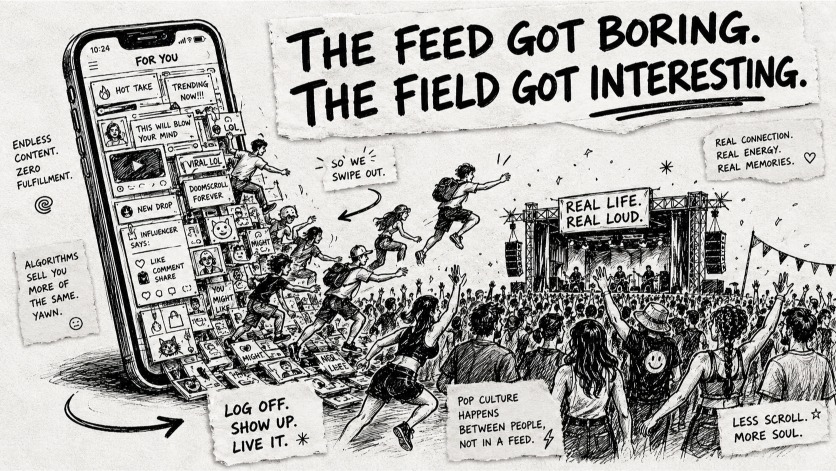
One of the biggest pop culture trends in 2026 is not another app.
It’s getting out of the house.
People are drowning in content. Their phones are full. Their feeds are cooked. Every second post feels like a brand pretending to be a person or a person pretending to be a brand.
Festivals offer the opposite.
A place. A crowd. A shared moment. A story that actually happened.
That’s why events like Fete de la Musique in Paris matter. The Guardian reported in June 2026 that the French music celebration, originally launched in 1982, has become a major cultural draw for Black British and American visitors, fuelled by TikTok, word of mouth and the global pull of Black Francophone music. [The Guardian]
That’s the deeper trend.
Music festivals are no longer just music programming.
They are cultural gravity.
They pull people into a scene.
A sound. A look. A feeling. A shared mythology.
That is why the best festivals become more than the sum of the timetable.
You don’t just remember who played.
You remember who you were with.
You remember the walk in.
You remember the moment the crowd moved as one.
You remember being tired, sunburnt, broke and weirdly happy.
That’s the product.
Memory.
Not access.
Memory.
Solo and family festivalgoers are not edge cases anymore
The old image of a festivalgoer is outdated.
It’s not just drunk twenty-somethings in a tent city making decisions their knees will regret by 35.
The audience has widened.
Ticketmaster’s reporting found almost one in three fans has attended a festival alone, while nearly one in five are open to trying it. [Ticketmaster report summary]
That matters.
Solo attendance is not weird anymore.
It’s practical.
Some people want flexibility. Some want to see a specific artist. Some don’t want to negotiate their joy through a group chat full of flaky adults. Understandable.
Family festival attendance is also part of the shift. Festivals are becoming holiday alternatives, cultural outings and multi-generational events, not just chaos weekends for people who think sleep is optional.
This changes how festivals need to be designed.
A solo attendee needs welcome points, safety, clear navigation and ways to connect without feeling like a spare part.
A family needs comfort, shade, toilets, food, safety and programming that doesn’t treat kids as a logistical inconvenience.
Older fans need access, seating, calmer areas and the right to enjoy live music without camping beside someone called Brayden doing nangs at 4am.
Different people need different versions of the same festival.
That’s not pandering.
That’s knowing the customer.
Micro-events are the secret weapon
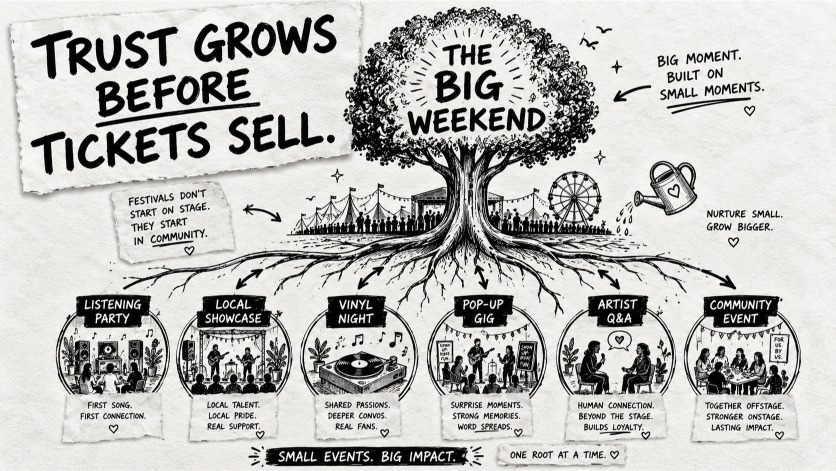
The future of festivals may not start with the festival.
It may start with smaller things.
Listening parties. Local showcases. Artist Q&As. Vinyl nights. Pop-up gigs. Club takeovers. Community events. Genre nights. Small collaborations with bars, record shops, breweries, venues and councils.
These are not little extras.
They are how trust gets built.
A festival that disappears for eleven months and then comes back screaming ‘EARLY BIRD TICKETS NOW ON SALE’ is doing the event version of texting ‘you up?’ after ignoring someone for a year.
Don’t be that festival.
Micro-events give organisers three things the big event can’t always provide safely:
A way to test demand. A way to build community. A way to create content without betting the entire farm.
They also keep the audience warm.
Because the best festivals don’t feel like one weekend.
They feel like a world people can step in and out of across the year.
The main festival becomes the peak moment.
Not the only moment.
AI will help festival marketing. It won’t fix boring.
Yes, AI will be part of the future.
Of course it will.
AI can help festivals segment audiences, personalise email journeys, test creative, manage customer service, forecast demand, build itineraries and repurpose content faster than a marketing assistant running on caffeine and resentment.
Pollstar Live! 2026 included programming across marketing, fan engagement, sustainability, ticketing and the future of live entertainment, showing how much industry attention is now going into smarter operating models and technology. [Pollstar]
But let’s not get carried away.
AI cannot fix a dull festival.
It cannot create culture from nothing.
It cannot make a generic event feel meaningful.
It cannot turn bad toilets into good memories.
It cannot make people care if the core idea is beige.
Give a boring organiser AI and you get boring at scale.
Congratulations.
You automated beige.
The real advantage goes to festivals that already understand their audience, then use AI to serve them better.
Not spam them harder.
What festival organisers should actually do in 2026
Here’s the useful bit.
Not the ten trends to watch fluff.
The actual stuff.
Pick a side
Who is this for?
Really.
Not music lovers.
That’s not an audience. That’s a panic attack in a marketing meeting.
Be specific.
The more clearly you define who belongs, the easier it is for the right people to feel pulled in.
Stop selling only the line-up
The line-up matters.
But the line-up is not the whole product.
Sell the world.
The crowd. The energy. The ease. The rituals. The story. The reason someone will feel stupid for missing it.
Treat comfort like strategy
Toilets are strategy.
Shade is strategy.
Transport is strategy.
Water is strategy.
Clear exits are strategy.
The things people complain about are usually the things that decide whether they come back.
Make the full cost easier to understand
Ticket price is only one part of the pain.
Help people plan.
Show transport options. Explain accommodation early. Offer day tickets where possible. Bundle value where it makes sense. Make the decision feel less risky.
The easier you make the decision, the earlier people can buy.
Build community before you sell
Don’t only talk to people when you want money.
Run smaller events. Share artist discovery. Build playlists. Create proper email content. Partner locally. Make people feel part of the thing before the big ticket push.
Community is not a slogan.
It’s repetition.
Use social media to show proof, not polish
People don’t need another perfect promo video.
They need evidence.
Show the real crowd. Show the real vibe. Show the moments. Show the weird bits. Show why the festival feels alive.
Too much polish makes an event look fake.
Too little proof makes it look risky.
Find the middle.
So, what is the future of music festivals in 2026?
The future is not bigger.
It’s clearer.
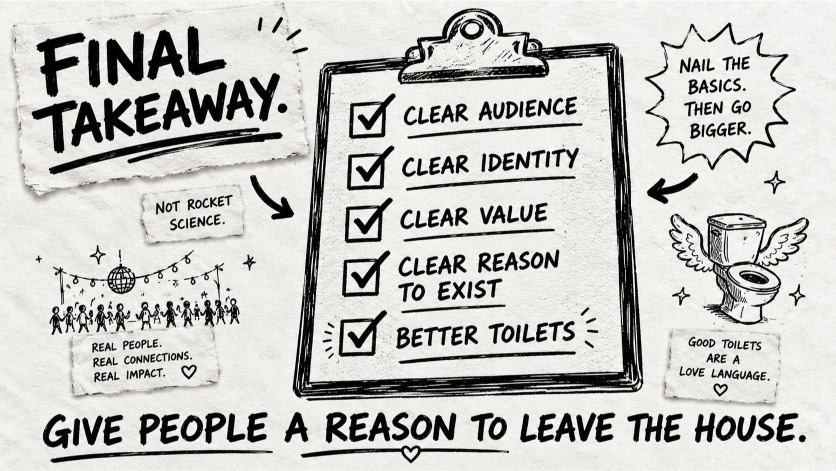
Clear audience. Clear identity. Clear value. Clear reason to exist.
The festivals that survive won’t be the ones trying to please everyone.
They’ll be the ones that mean something specific to someone specific.
Because people still want music.
They still want crowds.
They still want connection.
They just don’t want to be rinsed financially, treated like cattle, and served a recycled line-up with a side of lukewarm chips.
In 2026, people don’t need another event.
They need a reason to leave the house.
Give them one.
FAQ: Music Festival Trends 2026
What are the biggest music festival trends in 2026?
The biggest music festival trends in 2026 are niche festivals, stronger community-building, social media-led discovery, comfort upgrades, sustainability, micro-events, solo attendance, family-friendly programming and sharper festival identities.
Are music festivals dying?
No. Music festivals are not dying, but generic and poorly positioned festivals are under pressure. Demand for live music remains strong, but fans are more selective because tickets, travel, food, drinks and accommodation are all more expensive.
Why are festivals struggling?
Festivals are struggling because costs have risen across production, touring, insurance, staffing, logistics and infrastructure. At the same time, fans are buying tickets later and thinking harder about total cost.
Why are niche festivals becoming more popular?
Niche festivals are growing because they give fans a clearer sense of identity and belonging. A specific scene, genre or cultural focus can feel more meaningful than a broad festival trying to appeal to everyone.
How is social media changing festivals?
Social media now shapes how people discover, judge and remember festivals. Fans often decide whether an event feels right based on short videos, crowd clips, creator content and the visible culture around the festival.
What do Gen Z want from festivals?
Gen Z want value, discovery, social proof, safety, shareable moments and events that feel culturally relevant. They also need clearer reasons to justify the cost.
Why does comfort matter at festivals?
Comfort matters because fans are less willing to pay premium prices for a poor experience. Toilets, shade, water, seating, phone charging, transport and crowd flow all affect whether people return.
What should festival organisers focus on in 2026?
Festival organisers should focus on clear positioning, audience trust, better site experience, flexible ticketing, social proof, year-round community-building and practical sustainability. The goal is not just to sell tickets. It is to make the event feel worth leaving the house for.
Other Articles you may like
- Bluesfest collapse / festival trust: The REAL Reason Bluesfest Fell Apart: From Sold Out to Collapse
- Music economics / streaming context: Artists Don’t Hate Spotify. They Hate the Maths.
- Music identity / pop culture context: The Most Influential Music Genre of All Time? It’s Hip-Hop
- AI / channel behaviour context: AI Isn’t Replacing Marketing Channels. It’s Adding Another Layer.
Resource links
- Live Nation Entertainment Q1 2026 results: https://newsroom.livenation.com/news/live-nation-entertainment-reports-first-quarter-2026-results/
- Creative Australia / Music Australia: live music demand and cost-of-living pressure: https://creative.gov.au/news-events/news/strong-audience-demand-live-music-lives-despite-cost-living-pressures
- The Guardian: Bluesfest liquidation and ticket-holder debt: https://www.theguardian.com/australia-news/2026/mar/14/bluesfest-owes-ticket-holders-23m-as-bands-gutted-over-cancellation
- New Industry Focus: Ticketmaster UK festival trends report summary: https://newindustryfocus.com/articles/ticketmaster-releases-report-on-uk-festival-trends
- The Guardian: Fete de la Musique and offline pop culture gathering: https://www.theguardian.com/music/2026/jun/24/fete-de-la-musique-paris-music-black-diaspora
- Pollstar Live! 2026 schedule / industry themes: https://news.pollstar.com/2026/01/21/schedule-announced-for-pollstar-live-2026/
- Jay Clair: The REAL Reason Bluesfest Fell Apart: https://www.jayclair.com/music-insights/the-real-reason-bluesfest-fell-apart/