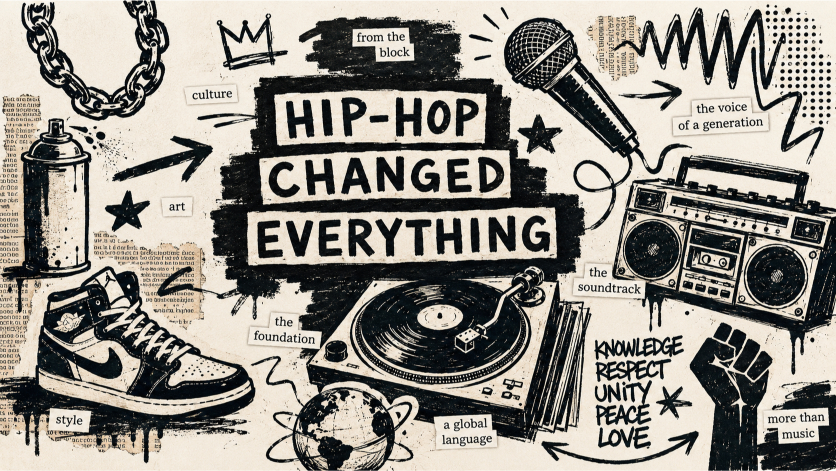
Hero image: Hip-hop as the cultural force connecting music, fashion, language and identity.
There are a few music arguments designed to ruin a perfectly good dinner.
Best frontman ever.
Most overrated band.
Whether Oasis were actually brilliant or just two angry haircuts with guitars.
But this one might be the big one:
What is the most influential music genre of all time?
Most people will say rock.
Fair answer. Safe answer. Dad answer.
Rock gave us rebellion, volume, stadiums, leather jackets, and men in their 50s still arguing about guitar tone like it’s a matter of national security.
Others will say jazz.
Also fair. Jazz rewired music. It broke structure, bent notes, messed with timing, and gave every music student something to pretend they understand.
Pop? Sure. Pop ate everything and sold it back to us with better lighting.
But if we’re talking about the genre that didn’t just change music, but changed language, fashion, politics, technology, identity, advertising, youth culture and the entire idea of what a song could be?
It’s hip-hop.
And no, that’s not me trying to be edgy.
That’s the uncomfortable bit.
Because hip-hop didn’t just become popular.
It became infrastructure.
Music Was Never Just Music
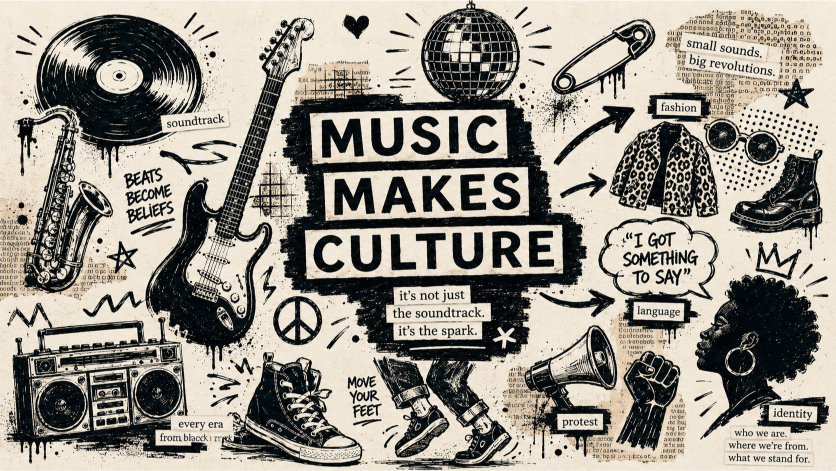
Section image: Music does not just reflect culture. It makes it.
Music has always been more than sound.
It’s memory with a chorus.
You hear one song and suddenly you’re back in a car, a bedroom, a nightclub, a terrible haircut, a breakup, a victory, a moment you thought you’d forgotten.
For me, music started at home.
My dad had one of those record collections that made no logical sense and somehow made perfect sense. Bob Marley. Stevie Wonder. Creedence Clearwater Revival. Led Zeppelin. Then, out of nowhere, Engelbert Humperdinck, because apparently musical whiplash was part of the family experience.
He’d crank the volume, and I’d dance around like an idiot.
Not a gifted idiot either.
Just an idiot.
But that’s where it got me. Music wasn’t background noise. It was alive. It had temperature. It had attitude. It could make a room feel bigger than it was.
That’s the thing about music.
It doesn’t just reflect culture.
It teaches culture how to walk.
Rock taught teenagers they didn’t have to behave.
Jazz taught musicians the rules were optional.
Disco gave people the dancefloor as church.
Punk said, ‘Actually, you don’t need permission or talent, just a pulse and a grievance.’
Then hip-hop turned up and said:
‘Cool. We’ll take all of that. Then we’ll sample it, loop it, rhyme over it, wear it differently, rename it, sell it, protest through it, and make the world talk like us.’
That’s not influence.
That’s a hostile takeover.
Hip-Hop Didn’t Arrive Polished. That Was the Point.
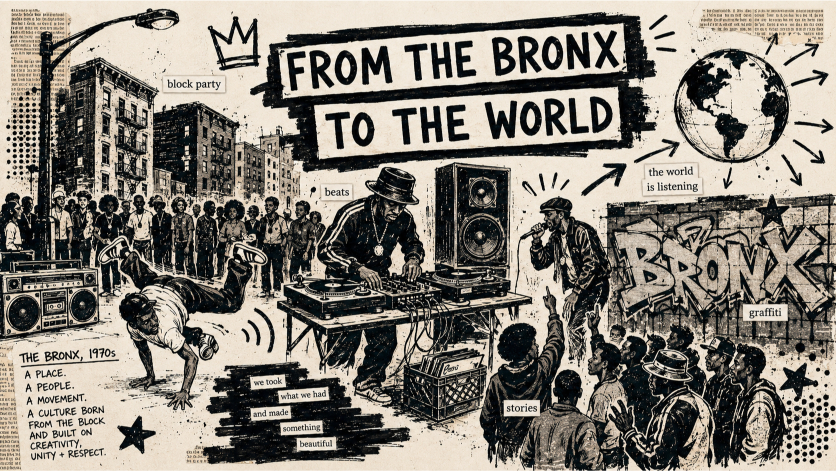
Section image: From Bronx block parties to a global cultural language.
Hip-hop didn’t come from boardrooms, conservatoriums, or some bloke called Nigel deciding the youth market needed ‘urban energy.’
It came out of the Bronx in the 1970s.
Not the glossy brochure version of New York. The hard version. Communities dealing with poverty, neglect, racism, crime, burned-out buildings, and systems that had basically shrugged and walked off.
African American, Afro-Caribbean and Latino young people took the scraps around them and built a culture out of them: DJing, MCing, breaking, graffiti, style, language, and knowledge of self. Columbia School of Social Work describes hip-hop as emerging from those communities and becoming a force for identity, belonging, expression, healing and social change.
That matters.
Because hip-hop wasn’t born as a product.
It was born as a workaround.
No instruments? Use turntables.
No stage? Use the park.
No power? Find a streetlight.
No media coverage? Become the media.
On August 11, 1973, DJ Kool Herc’s ‘Back to School Jam’ in the Bronx became one of the foundational moments in hip-hop history. Herc extended instrumental breaks so dancers could keep moving, and the blueprint started forming in real time, as outlined by Columbia School of Social Work.
That’s what makes hip-hop different.
It didn’t wait for the machine.
It built a better one from broken parts.
The Biggest Musical Shift Wasn’t The Beatles. Awkward.
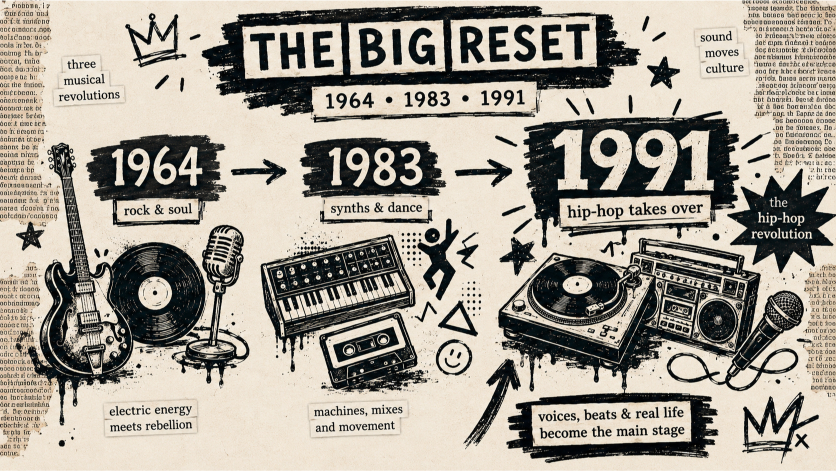
Section image: The three musical revolutions – 1964, 1983 and 1991.
Here’s where it gets spicy.
A Royal Society Open Science study looked at the evolution of the US Billboard Hot 100 between 1960 and 2010. The researchers analysed around 17,000 songs and identified three major musical revolutions: around 1964, 1983 and 1991.
1964 makes sense.
That’s rock, soul, doo-wop, The Beatles, The Rolling Stones, Motown, and the start of the modern pop era.
1983 also makes sense.
Synths, drum machines, new wave, disco hangovers, hard rock, big choruses, bigger hair, and production so shiny you could probably see your own cocaine problem reflected in it.
But 1991?
That was hip-hop.
The ABC’s summary of the research put it bluntly: hip-hop and rap were described by the researchers as possibly the single most important event shaping the musical structure of the American charts during the period studied.
Bigger than disco.
Bigger than metal.
Bigger than the British Invasion.
Cue angry Beatles fans clutching their vinyl.
But the argument isn’t that The Beatles didn’t matter.
Of course they mattered.
The argument is that hip-hop changed the actual machinery of popular music.
Songs no longer needed to be built around traditional chord progressions and sung melodies. They could be built on beats, loops, samples, rhythm, speech, attitude and repetition.
The Royal Society paper specifically links the rise of hip-hop and rap with tracks using fewer identifiable chord structures and more energetic speech-based timbres.
That is a massive shift.
Hip-hop didn’t just add another genre to the shelf.
It changed how the shelf was built.
Sampling Wasn’t Theft. It Was Time Travel.
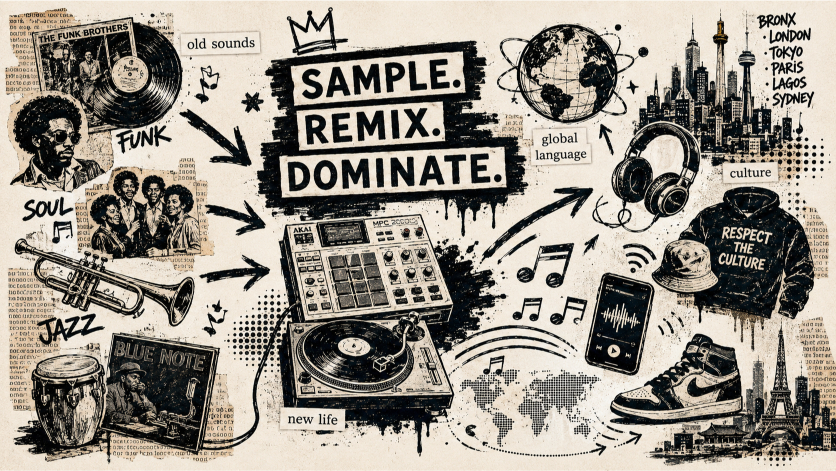
Section image: Sampling turned the past into raw material for the future.
One of the laziest criticisms of hip-hop has always been:
‘They just sample other songs.’
Right.
And filmmakers ‘just point cameras at things.’
Sampling is not copying. Bad sampling is copying. Good sampling is resurrection.
Hip-hop took old records and made them speak again.
A drum break from a forgotten funk track.
A bassline from a soul record.
A horn stab from jazz.
A guitar riff from rock.
A vocal phrase buried in some dusty record crate.
Suddenly, yesterday had a new job.
That’s what sampling really did. It collapsed time.
It turned music history into raw material.
This is where hip-hop becomes bigger than a genre. It becomes a method. A way of making culture by remixing culture.
And now everything does it.
Pop does it.
Dance does it.
Advertising does it.
TikTok does it every six seconds before your brain has time to defend itself.
The remix mindset is everywhere.
Hip-hop normalised it.
Hip-Hop Changed More Than Music
This is where rock starts sweating.
Because yes, rock had fashion. Rock had politics. Rock had rebellion.
But hip-hop spread like software.
It changed how people dressed. Sneakers, tracksuits, oversized fits, gold chains, sportswear, streetwear, luxury fashion, logo culture. Half the fashion industry spent decades pretending it invented things hip-hop had already made cool.
It changed language.
Slang moved from neighbourhoods to lyrics, from lyrics to schools, from schools to offices, from offices to LinkedIn posts where someone eventually uses it wrong and ruins it for everyone.
It changed advertising.
Brands didn’t just want hip-hop music in campaigns. They wanted hip-hop credibility. They wanted the posture, the rhythm, the confidence, the cool. Which is hilarious, because nothing says ‘street culture’ quite like a global corporation asking whether the campaign has enough edge.
It changed politics.
Public Enemy, Tupac, N.W.A., Kendrick Lamar and countless others used rap as reportage. Not the polished kind. The raw kind. The kind that says, ‘Here’s what it feels like from here.’
Columbia notes hip-hop’s role in giving voice to unheard communities, confronting racism, police brutality, inequality and social conditions that mainstream institutions often ignored or misunderstood.
That is the power of hip-hop.
It didn’t just entertain people.
It documented what polite society preferred not to look at.
But Is Hip-Hop Still Dominant?
This is where the conversation gets interesting.
Because if you grew up on 90s hip-hop, modern hip-hop can feel… different.
That’s the polite version.
The less polite version?
Sometimes it feels like the bars got traded in for vibes, the storytelling got replaced by mood lighting, and half the genre now sounds like someone recorded a voice note after taking cough syrup in a nightclub toilet.
Yes, I know. I sound old.
I can hear myself becoming the bloke yelling, ‘They don’t make albums anymore!’ while holding a copy of Illmatic like it’s a sacred text.
But there’s a real point under the grumbling.
Hip-hop has changed because the world changed.
Albums used to feel like events. You waited for them. Bought them. Sat with them. Read the liner notes. Argued about track three. Pretended you caught every reference on the first listen.
Now music is endless.
Songs arrive, trend, disappear, get sped up, slowed down, memed, playlisted, skipped, rediscovered, and used under videos of people making protein desserts that look like wet cement.
Hip-hop isn’t outside that system.
It helped create it.
And like every dominant culture, it now has to live inside the machine it helped build.
The data shows the picture is more complicated than ‘hip-hop is dead’ or ‘hip-hop still rules everything.’ Luminate reported that R&B/Hip-Hop remained the leading US core genre in 2024 with a 25.3% share of on-demand audio streaming, but also noted that its lead had been shrinking due to competition from genres like Latin and Country.
So no, hip-hop hasn’t vanished.
But it may no longer feel as dangerous as it once did.
That’s what happens when rebellion wins.
Eventually it gets a brand partnership.
The Real Influence Is That Hip-Hop Became Invisible
The biggest sign of hip-hop’s influence isn’t that everyone listens to rap.
It’s that even when people aren’t listening to rap, they’re often listening to something hip-hop changed.
Pop vocals now move with rap cadences.
Country artists borrow trap drums.
Rock bands use loops and programmed beats.
R&B and hip-hop are basically in a long-term situationship.
Every pop star wants a little swagger, a little spoken rhythm, a little street-level credibility, even if it arrives via a marketing department and a stylist called Chloe.
That’s the real win.
Hip-hop became the grammar of modern music.
You don’t always notice grammar when you’re speaking.
But it shapes every sentence.
So, Is Hip-Hop the Most Influential Genre of All Time?
I think it is.
Not because it sold the most records.
Not because every rapper is a genius.
Definitely not because every modern track with hi-hats deserves a museum exhibit.
Hip-hop is the most influential because it changed the rules of creation.
It proved you could build something new from fragments.
It gave people without access a way to be heard.
It turned the DJ into an architect, the MC into a journalist, the producer into a historian, and the sample into a portal.
Rock rebelled against the parents.
Hip-hop rebelled against the whole system.
Then it became the system.
That’s the uncomfortable brilliance of it.
The most influential genre of all time didn’t arrive wearing a crown.
It showed up at a block party, plugged into the street, looped the break, grabbed the mic, and made the world catch up.
Not bad for something they said wasn’t real music.
Funny how often the future starts as an insult.
References
– Columbia School of Social Work – 50 years of Hip-Hop
– Royal Society Open Science – The evolution of popular music