Musicians love blaming Spotify.
And honestly?
I get it.
You spend years writing songs, recording demos, playing to twelve people in a room that smells like stale beer and carpet regret, then you check your streaming payout and see enough money to buy half a sausage roll.
Of course you’re angry.
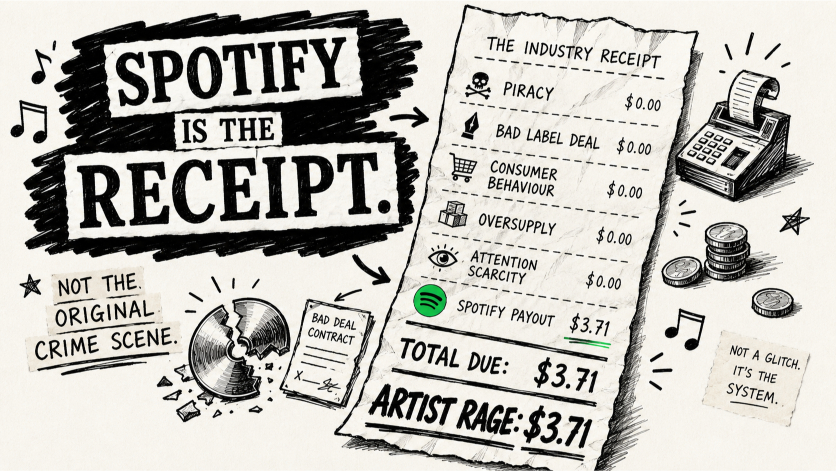
Nobody dreams of pouring their heart into music so they can earn $3.71 and an email from their distributor saying, “Good news, your track is gaining traction.”
Brilliant.
Put the kettle on. We’re rich.
But here’s the uncomfortable bit.
Spotify is not the original crime scene.
It’s the receipt.
The music industry was already broken long before Daniel Ek rocked up with an app, a green logo, and a business model that made every musician suspicious. Labels were taking massive cuts. Artists were signing terrible contracts. Piracy had trained an entire generation to believe music should cost nothing. Then streaming came along and did the one thing nobody else could do at scale.
It made people pay for music again.
Not enough, maybe.
Not perfectly.
Not in a way that makes every artist rich.
But more than zero.
And zero was where the industry was heading.
That’s the part people conveniently forget.
Before Spotify, the enemy wasn’t “low royalties.” The enemy was Napster, LimeWire, torrents, burned CDs, dodgy MP3 blogs, and your mate proudly saying, “Why would I pay for it when I can just download it?”
Beautiful cultural moment.
Absolute economic bin fire.
So when artists say Spotify devalued music, I get it.
But the harsher truth is this:
The public devalued music first.
Spotify just built a toll road through the wreckage.
The Golden Age Wasn’t That Golden
There’s a weird fantasy people have about the old music industry.
The CD era.
The record store era.
The era where people paid $25 for an album because they liked one song and had no choice but to cop the other eleven tracks like a hostage situation.
On the surface, it looked great.
Music had value. Albums sold. Record shops mattered. Labels had money. Bands had posters on bedroom walls. Everyone had a Discman that skipped if you breathed too aggressively near it.
Romantic stuff.
But for most artists?
The system was brutal.
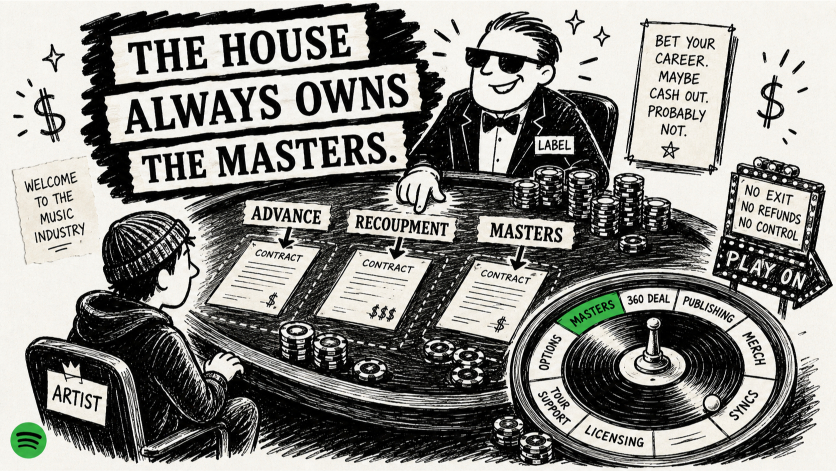
If you wanted to reach a mass audience, you needed a label. Not “nice to have.” Needed. You needed recording budgets, manufacturing, radio relationships, press, distribution, retail placement, and enough industry handshakes to make a normal person want to crawl into a cupboard.
And the price of entry?
Your masters.
Your royalties.
Your creative control.
Possibly your soul, depending on how shiny the lawyer’s shoes were.
The old industry wasn’t built to make artists rich. It was built to make labels rich. Artists were often given advances that looked like gifts but behaved like debt. The label paid upfront, then recouped from the artist’s future earnings. Studio time? Recouped. Marketing? Recouped. Video clips? Recouped. Tour support? Recouped.
By the time the artist finally made money, everyone else had already eaten.
It was less “rock and roll dream” and more “financial hostage negotiation with better hair.”
Yes, some artists made a fortune.
But that’s the trick, isn’t it?
We remember the winners.
We remember Michael Jackson. Madonna. Metallica. Nirvana. Prince. The Beatles. The giants.
We don’t remember the thousands of bands who got signed, shelved, underpaid, mismanaged, dropped, or trapped in contracts that aged worse than a tribal tattoo.
The old model had scarcity.
Scarcity created value.
But it also created gatekeepers.
And if you were outside the gate, good luck.
You could be brilliant and still go nowhere because some bloke in a label office didn’t hear a single.
That wasn’t a golden age.
That was a casino with a better soundtrack.
Then Piracy Blew the Door Off
Then came the internet.
And the music industry did what big industries usually do when technology changes everything.
It panicked.
Napster arrived. Then LimeWire. Then torrents. Suddenly music was everywhere, instantly available, and free if you had a dodgy enough computer and no fear of downloading a file called Metallica_New_Album_FINAL_REAL.exe.
The industry had been built around control.
Control the recording.
Control the manufacturing.
Control the radio.
Control the shop shelf.
Control the release cycle.
The internet looked at all that and said, “Cute.”
Then it torched the model.
Consumers didn’t wait for permission. They moved first. And once people got used to free music, getting them back to paying full album prices was basically trying to put toothpaste back into the tube with a leaf blower.
People didn’t just stop buying music because they hated artists.
They stopped because the behaviour changed.
Music became instant.
Music became searchable.
Music became portable.
Music became abundant.
And once something becomes abundant, the economics change.
That’s not Spotify’s fault.
That’s the internet doing what the internet does: taking a tidy business model, flipping the table, then asking why everyone looks upset.
By the early 2000s, the recorded music industry had a massive problem.
The old product was dying.
The new behaviour had already arrived.
And nobody had a clean way to monetise it.
iTunes helped, sure. It got people paying for downloads. But it was still a halfway house. You owned files. You synced devices. You bought one song at a time. It was better than piracy, but it wasn’t the final answer.
Streaming was.
Not because it was perfect.
Because it matched the behaviour.
People wanted access, not ownership.
And Spotify gave them legal access at scale.
That matters.
Spotify Didn’t Kill Music. It Made Paying Feel Normal Again.
This is the part that annoys people.
Spotify did not kill the music industry.
It helped drag it out of a ditch.
Today, Spotify is not a niche music app. It is the global jukebox with Wi-Fi. In Spotify’s Q4 2025 earnings update, the company reported 751 million monthly active users and 290 million premium subscribers.
And yes, Spotify pays the music industry a lot of money. In Spotify’s 2026 Loud & Clear update, the company said it paid more than $11 billion to the music industry in 2025, bringing lifetime payouts to nearly $70 billion. Spotify also said roughly half of those royalties were generated by independent artists and labels.
Now, before someone starts frothing into their oat latte, yes – that money does not all go directly to artists.
That is the point.
Spotify pays rights holders.
Labels.
Publishers.
Distributors.
Collection societies.
Then the money moves through contracts.
And contracts are where hope goes to get mugged.
So when an artist screams, “Spotify doesn’t pay me enough,” the first question should be:
Spotify?
Or your deal?
Because those are not always the same thing.
A signed artist on a terrible contract and an independent artist with better rights ownership are not playing the same game. One is swimming with ankle weights. The other might still be swimming through sewage, but at least the weights are off.
That distinction matters.
Blaming Spotify for every bad payout is too easy.
It’s like blaming the EFTPOS machine because your boss underpaid you.
The machine processed the payment.
It didn’t write your contract.
The Per-Stream Argument Sounds Worse Than It Is
The most common complaint is simple:
“Spotify only pays fractions of a cent per stream.”
True.
And emotionally, that sounds insulting.
One stream feels like one listen. One listen feels like one tiny sale. So when the payout is tiny, the artist feels robbed.
But this is where the maths gets messy.
A CD sale looked better because the money arrived upfront.
Let’s say someone bought your CD in the 90s for $20.
Beautiful.
Actual money.
A physical thing.
Plastic disc. Booklet. Maybe lyrics. Maybe a hidden track, because apparently we had patience back then.
But how much did the artist actually get?
After the label, retailer, distributor, manufacturing, marketing, recouped costs, band splits, management, and a few mysterious deductions that probably had names like “container handling administration adjustment,” the artist might only get a small slice.
Then that fan might play the album hundreds of times.
So the upfront payment looked big.
But per listen?
Not always wildly different.
The difference is psychological.
CD money felt like a sale.
Streaming money feels like being drip-fed by a leaky tap.
And nobody writes love songs about leaky taps.
Streaming changed the unit of value.
The old model monetised ownership.
The new model monetises attention over time.
That’s a very different beast.
And it’s why the per-stream debate on its own is too narrow. It’s not irrelevant. But it’s not the whole picture.
A stream is not a CD sale.
It’s not meant to be.
It’s one tiny signal in a much bigger attention economy.
The Real Scarcity Is No Longer Distribution. It’s Attention.
This is the bit artists really need to understand.
Distribution used to be scarce.
Now it’s basically free.
You can record music in your bedroom. Upload it through DistroKid, TuneCore, CD Baby, or another distributor. Have it land on Spotify, Apple Music, YouTube Music, Amazon Music and everywhere else without begging a label executive for a meeting.
That is insane.
Seriously.
An artist in 1987 would think that was witchcraft.
They had to press vinyl, manufacture CDs, get stocked in stores, fight for radio, print posters, call magazines, and hope someone in the industry cared.
Now you can release a track globally from a laptop while eating cereal in your underwear.
Progress is weird.
But here’s the catch.
When everyone can release music, everyone does.
The bottleneck has moved.
It’s no longer “Can I get my music out?”
It’s “Can anyone give a shit?”
That is the new war.
Not access.
Attention.
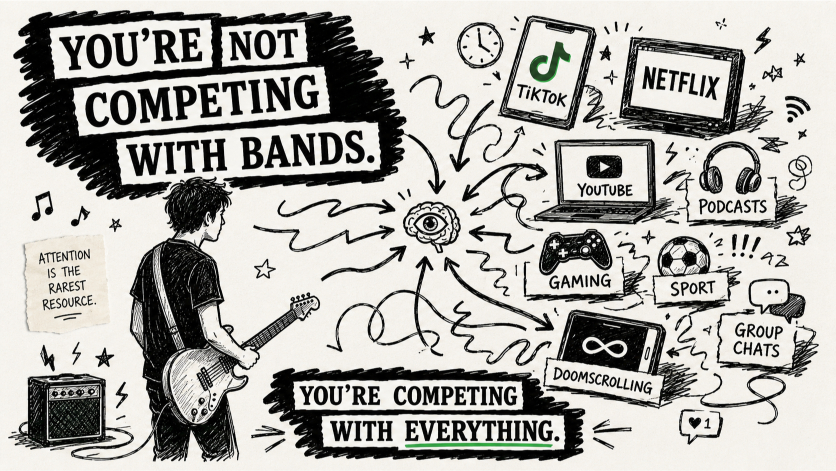
And attention is an absolute bloodbath.
You’re not just competing with other musicians anymore. You’re competing with podcasts, Netflix, YouTube, TikTok, gaming, group chats, newsletters, doomscrolling, sport, AI slop, and some bloke filming himself reviewing servo pies.
That’s the market.
Good luck.
This is why streaming feels harsh. The platform gives artists access to the world, but the world is distracted, overstimulated, and one thumb movement away from never hearing you again.
That’s not a music industry problem.
That’s a human attention problem.
And it is only getting worse.
More Artists Are Making Money. That Doesn’t Mean Everyone Is.
Here’s where the conversation gets uncomfortable.
The streaming era has created more opportunity.
It has also created more competition.
Both things are true.
The global recorded music market continues to grow. IFPI’s Global Music Report 2026 reported global recorded music revenues of US$31.7 billion in 2025, with streaming accounting for 69.6% of global recorded music income.
Spotify’s Loud & Clear takeaways also state that more than 13,800 artists generated at least $100,000 from Spotify alone in 2025, and more than 1,500 artists generated over $1 million in Spotify royalties.
That’s not nothing.
In fact, that’s significant.
But it also doesn’t mean the system is magically fair.
Because for every artist making six figures, there are thousands making lunch money.
That’s how open markets work.
Opening the gate doesn’t guarantee a career.
It just means more people get to enter the arena.
And the arena is full of elbows.
This is where some artists get stuck. They hear “more opportunity” and think it means “more guaranteed income.”
No.
It means the wall is lower.
It does not mean the climb is easy.
That’s the brutal truth of democratisation.
When everyone gets a shot, everyone also gets competition.
Spotify Is a Tool, Not a Retirement Plan
This is probably the single biggest mindset shift artists need to make.
Spotify is not your entire business model.
It is distribution.
It is discovery.
It is data.
It is a credibility signal.
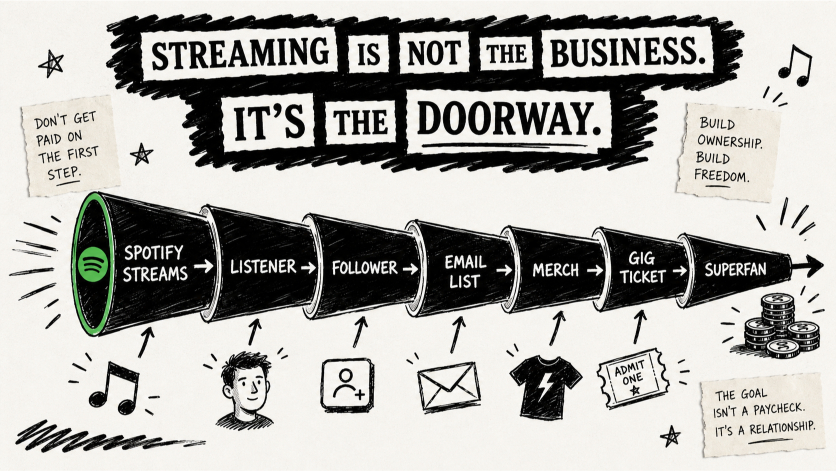
It is a funnel.
But if your whole plan is “I’ll upload songs and streams will pay my rent,” you are bringing a spoon to a knife fight.
Streaming can support a music career.
It rarely is the whole career.
The artists who understand this use Spotify as part of a bigger machine.
They use it to build audience.
Then they move fans into deeper relationships.
Email lists.
Merch.
Touring.
Vinyl.
Patreon.
Bandcamp.
YouTube.
Sync licensing.
Private communities.
Limited drops.
Crowdfunding.
Real fan connection.
Not “please follow me for updates” connection.
Actual connection.
The kind where people care enough to spend money.
Because casual listeners are nice.
Superfans pay bills.
A million passive streams might look cool in a screenshot.
But a thousand genuine fans who buy your merch, show up to gigs, back your projects, and tell their mates?
That’s a career.
Spotify can help you find them.
But it won’t build the whole business for you.
That part is still on you.
Annoying, I know.
The Labels Still Deserve More Heat Than They Get
Here’s the part that often gets ignored because it’s less convenient.
Labels still hold enormous power.
Streaming did not magically remove the old industry. It just gave it new plumbing.
Major labels still negotiate huge licensing deals. They still own catalogues. They still control rights. They still take large shares before many artists see anything meaningful.
And in some cases, they are now making money from streaming while artists blame the platform doing the payout processing.
Neat trick.
The old gatekeepers adapted.
They didn’t disappear.
They just put on a hoodie and started using words like “ecosystem.”
So yes, ask hard questions about Spotify.
Ask whether the pro-rata payout model is the best one.
Ask whether user-centric payments would be fairer.
Ask whether smaller and mid-tier artists are getting squeezed.
Ask whether playlist power has created a new kind of gatekeeping.
Ask whether algorithmic discovery rewards quality, consistency, vibes, or just whatever keeps people passively listening while they clean the kitchen.
All fair questions.
But also ask:
Who owns the master?
Who owns the publishing?
Who controls the contract?
Who takes the first cut?
Who negotiated the licensing deal?
Who benefits from the current structure?
Because if we’re going to be angry, let’s at least aim the cannon properly.
The Payout Model Probably Needs Work
Now, none of this means Spotify is perfect.
Let’s not get silly.
The platform has real issues.
The payout model can feel brutal for smaller artists. The pro-rata system tends to reward scale. Background listening can be valued similarly to deep fandom. Playlist placement can make or break momentum. Fraud, bots, fake artists, mood playlists, and AI-generated sludge are all real problems.
The music industry has always attracted parasites.
Streaming just gave them laptops.
So yes, the model should keep evolving.
A few alternatives are worth discussing.
A user-centric model would mean your subscription money goes to the artists you actually listen to, instead of being pooled across the platform.
That feels more emotionally fair.
If you spend all month listening to obscure doom folk recorded in a shed in Tasmania, maybe your subscription should support that artist rather than being diluted into the global pool.
There are complications, obviously.
There are always complications.
That’s how executives keep their jobs.
But the conversation is valid.
There may also be better ways to reward deeper fan engagement. A skipped song probably shouldn’t be treated the same as a song someone plays twenty times, saves, shares, and adds to every playlist they’ve ever made, including “sad walk but make it cinematic.”
The system can improve.
It should improve.
But improving the system is different from pretending the old one was better.
Because for most artists, it wasn’t.
The Old Industry Had Better Myths. The New Industry Has Better Access.
That’s the real trade-off.
The old music industry had romance.
Record shops.
Album launches.
Liner notes.
Mystique.
Tour posters.
Big advances.
A sense that music mattered because you had to physically go and buy it.
But it also had gatekeepers, bad contracts, limited access, and a very long line of artists who never got a shot.
The new industry has less romance.
It has dashboards.
Algorithms.
Playlist pitching.
Release strategies.
Content calendars.
Analytics.
Tiny royalty statements that make you question your life choices.
Not exactly “sex, drugs and rock and roll,” is it?
More like “metadata, thumbnails and mild despair.”
But it also has access.
Global reach.
Lower recording costs.
Direct distribution.
Fan data.
Independent pathways.
Niche audiences.
Artists making money without needing to be global household names.
That matters.
The music industry didn’t become fair.
It became more open.
Those are different things.
And honestly, open but brutal is probably still better than closed and brutal.
At least now you can get in.
So Should Artists Be Thankful for Spotify?
Thankful might be too strong.
Nobody needs to send Daniel Ek a muffin basket.
But artists should be honest about what Spotify actually is.
It is not a saviour.
It is not the devil.
It is not a charity.
It is not your record label, your manager, your merch table, your tour promoter, your therapist, or your mum telling you your new song is “really good, darling.”
It is a platform.
A massive one.
A flawed one.
A useful one.
And like every platform, it gives and takes.
It gives artists access to listeners all over the world.
It takes control of the listening environment.
It gives data.
It takes margin.
It gives discovery.
It creates dependency.
It gives independent artists a path.
It buries millions of songs in the mud.
That’s the deal.
Not perfect.
Not evil.
Just modern.
The Real Question
The real question isn’t:
“Is Spotify fair?”
That’s too simple.
The better question is:
“Compared to what?”
Compared to piracy?
Spotify is better.
Compared to old label deals?
For many artists, Spotify is better.
Compared to a fantasy world where every artist is paid generously and audiences happily spend $30 on every album?
Sure, Spotify looks terrible.
But that world doesn’t exist.
It probably never did.
The music industry has always been hard. It has always been unfair. It has always rewarded a small number of winners while thousands of talented people fight for scraps.
Streaming didn’t invent that.
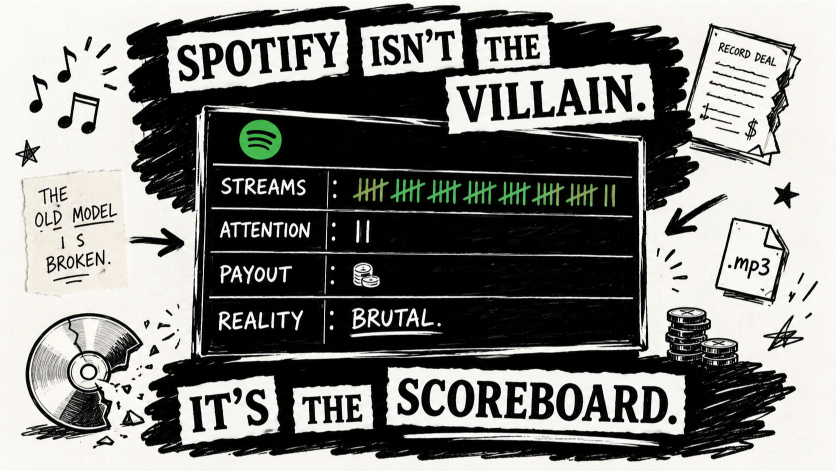
It just made the scoreboard visible.
And that might be why people hate it so much.
Because Spotify shows the ugly maths.
It shows how many people are listening.
How much each play is worth.
How much attention you actually have.
How small a song can feel inside a catalogue of more than 100 million tracks.
That visibility hurts.
But visibility is not the same as exploitation.
Sometimes the mirror is just rude.
Final Thought
Spotify didn’t destroy the music industry.
Piracy cracked it open.
Labels had already rigged it.
Consumers changed the rules.
Technology lowered the barrier.
And streaming turned the chaos into a business model.
Is it flawed?
Absolutely.
Should artists push for better payouts, fairer contracts, cleaner models, and less algorithmic nonsense?
Yes.
Loudly.
Annoyingly.
With receipts.
But blaming Spotify alone is lazy.
The problem is bigger than one platform.
It’s consumer behaviour.
It’s label economics.
It’s oversupply.
It’s attention scarcity.
It’s the uncomfortable fact that making music has never been easier, but getting people to care has never been harder.
That’s the real game now.
Spotify isn’t the villain.
It’s the scoreboard.
And if you hate the score, fair enough.
But don’t confuse the scoreboard with the sport.
Source Links Used
- Spotify Q4 2025 earnings: MAUs and subscribers
- Spotify Loud & Clear 2026 highlights: 2025 payouts and artist earnings
- Spotify Loud & Clear takeaways: royalty figures
- IFPI Global Music Report 2026: global recorded music revenue and streaming share
- Reuters: Spotify 2025 payout report
- Reuters: IFPI 2026 global recorded music revenue report