There is a big difference between using AI and producing AI slop.
A massive difference.
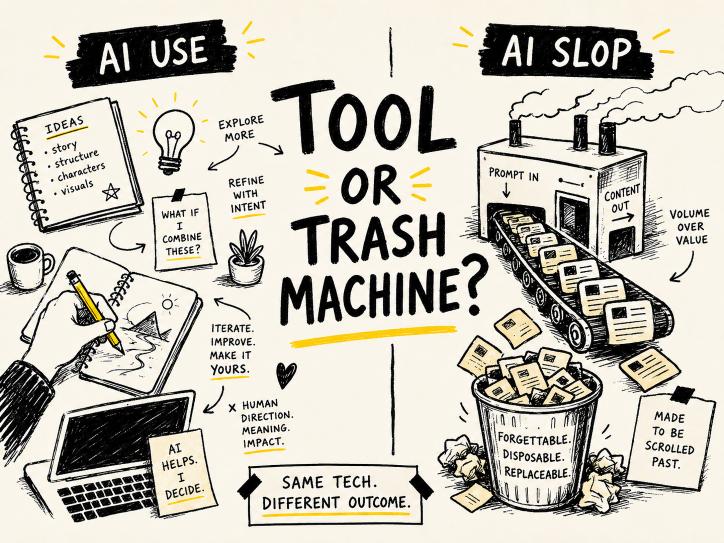
One is a tool.
The other is digital junk food with a prompt box.
And yet the internet keeps flattening the whole thing into the same lazy argument:
“AI bad.”
Very helpful. Very brave. Someone get this person a lanyard and a conference panel.
The truth is messier than that.
Some people use AI to think faster, edit sharper, test ideas, build drafts, explore angles, and get unstuck. Other people use it to pump out soulless digital landfill at industrial scale.
Those are not the same thing.
A chef using a blender is not the same as a factory pumping pink sludge into a nugget.
Same category of machine.
Completely different outcome.
Slop Is Not New. AI Just Gave It a Jetpack.
The word “slop” has become the perfect label for what people hate about low-effort AI content.
The term is not just internet slang anymore. Merriam-Webster named “slop” its 2025 Word of the Year and defines it as low-quality digital content usually produced in quantity by artificial intelligence. Which is beautifully brutal. Four letters. Whole internet explained.
But here’s the bit people keep missing.
AI did not invent slop.
It scaled it.
We had slop long before ChatGPT showed up wearing its little robot shoes.
We had junk TV. Clickbait headlines. SEO articles written for algorithms instead of humans. Recipe blogs that made you read someone’s childhood trauma before telling you how much flour goes in the banana bread. Motivational quotes over sunsets. Generic business books that say “be consistent” for 240 pages. Ads that look like they were approved by a committee of beige socks.
Slop has always existed because people have always accepted it.
Sometimes they even love it.
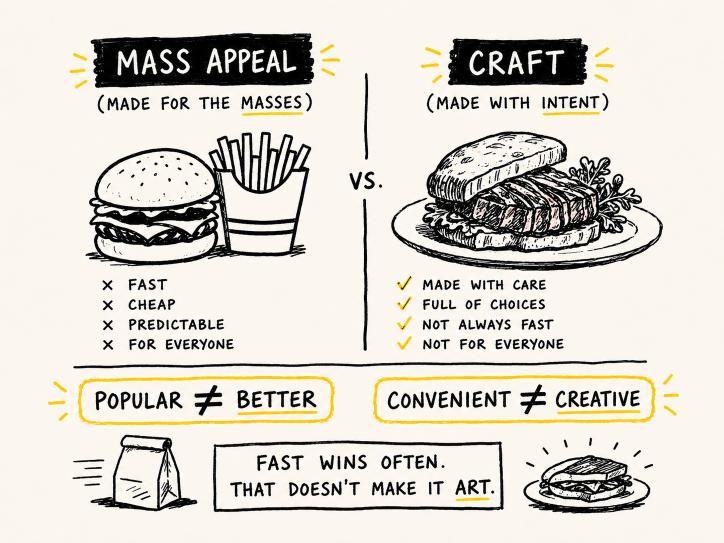
McDonald’s did not prove the local chef couldn’t cook. It proved people like fast, cheap, familiar food they don’t have to think about.
That’s just reality.
Mass appeal has never been the same thing as artistic merit.
A Big Mac outselling a handmade steak sandwich does not mean the steak sandwich failed as food. It means the Big Mac is easier to buy, easier to understand, easier to repeat, and backed by one of the most efficient distribution machines humanity has ever created.
Same with content.
Sometimes the dancing AI cat wins.
Sometimes the lazy carousel wins.
Sometimes the hollow motivational post gets 40,000 likes while your carefully crafted essay gets 73 views and one comment from someone who clearly didn’t read it.
Annoying? Yes.
New? Not even slightly.
People Are Already Using AI. That Argument Is Over.
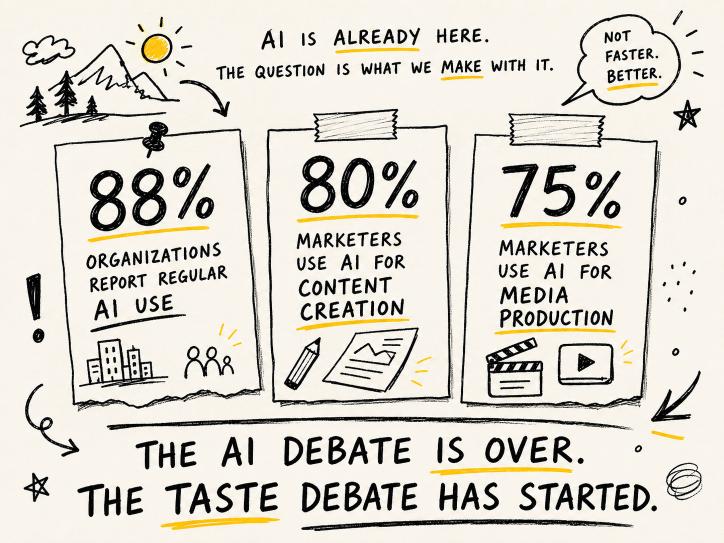
The “should people use AI?” debate is basically done.
People are using it.
Businesses are using it.
Marketers are definitely using it.
McKinsey’s 2025 global AI survey found that 88% of respondents report regular AI use in at least one business function, compared with 78% the previous year. The most common areas include IT, marketing, and sales, which tells you everything you need to know about why your feed suddenly looks like it was written by the same overconfident intern.
HubSpot’s 2026 State of Marketing Report says 80% of marketers use AI for content creation and 75% use it for media production.
So the question is no longer:
“Will people use AI?”
They already are.
That horse has bolted, joined a SaaS company, and started posting thought leadership carousels.
The better question is:
Is AI being used by someone with taste, judgement, and a point of view?
Or is it being used to shovel more beige content into the internet’s already overflowing bin?
That is the real line.
Not AI versus no AI.
Taste versus no taste.
Judgement versus no judgement.
A human with a tool versus a tool with no human in charge.
AI Use Still Has a Person Behind It
Using AI well is not about outsourcing your brain.
It is about extending your reach.
You still need the idea.
You still need the taste.
You still need the judgement.
You still need to know when the thing in front of you is good, bad, boring, fake-deep, trying too hard, or just corporate porridge in a nice bowl.
That’s the bit people skip.
AI can help you draft.
It cannot care for you.
AI can suggest ten angles.
It cannot know which one actually matters unless you do.
AI can sharpen a sentence.
It cannot give you a soul.
That remains annoyingly your job.
Good AI use still has fingerprints on it. You can feel the human behind the machine. There is a voice. A bias. A wound. A joke. A strange little detail that no machine would invent because no machine grew up in your house, had your parents, made your mistakes, listened to your music, or quietly judged people in supermarket queues.
That stuff matters.
That’s where the work lives.
AI Slop Feels Like the Person Left the Room
AI slop is not just “content made with AI.”
That’s too lazy.
AI slop is content where the human has clearly checked out.
No point of view.
No tension.
No risk.
No lived experience.
No strange detail.
No friction.
No reason to exist beyond “we needed to publish something.”
It is the article that says everything and nothing.
It is the image that looks polished but feels dead.
It is the LinkedIn post with perfect structure and zero pulse.
It is the fake news article written like a microwave trying to pass a journalism degree.
It is the children’s book on Amazon where every animal has six fingers and the moral is “friendship is good” because apparently the author was a toaster.
It is the SEO page that technically answers the question while making you feel like your brain has been wrapped in wet cardboard.
That’s slop.
Not because AI touched it.
Because nobody with taste stopped it.
The Audience Can Smell the Difference. Mostly.
Here’s where it gets interesting.
Audiences are not as stupid as some content teams clearly hope.
The Reuters Institute found that people can see some benefits of AI in news, like cheaper production and more up-to-date reporting, but they also expect AI to make news less transparent, less accurate, and less trustworthy.
That is the trust gap.
People don’t necessarily hate AI.
They hate the feeling that nobody human was steering the thing.
And the audience is weirdly contradictory about this, because of course they are. Humans are basically walking contradiction machines with snack preferences.
Bynder found that 50% of consumers could spot AI-written content. But when people were shown an AI-written article and a human-written article without labels, 56% preferred the AI version. Then, when asked how they feel about content they suspect is AI-generated, 52% said they become less engaged.
So people may like the thing.
Then hate the thing once they think a machine made it.
Beautiful.
Ridiculous.
Very human.
But it proves the bigger point. The issue is not always whether AI content can be readable, useful, or even enjoyable. Sometimes it can be.
The issue is trust.
Intention.
Effort.
Taste.
Did a human use AI to get closer to the point?
Or did someone type one lazy prompt, hit publish, and call it thought leadership?
That is the difference.
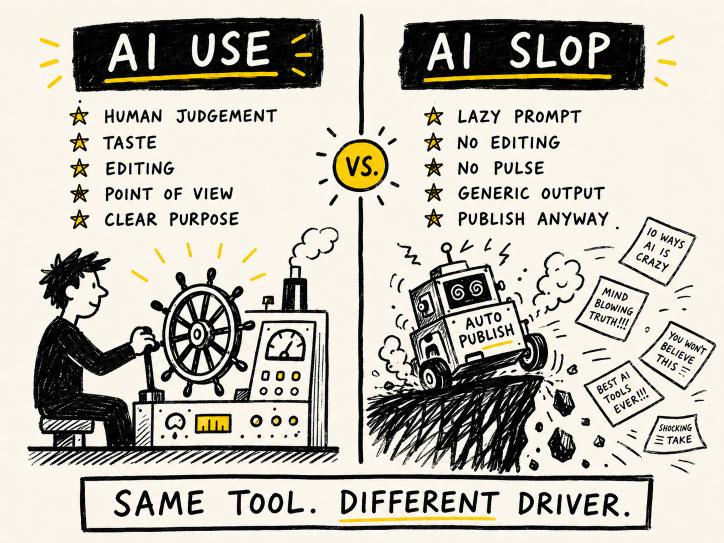
AI use still has a person behind it.
AI slop feels like the person left the room.
The Slop Machine Is Real
This is not just a vibes-based complaint.
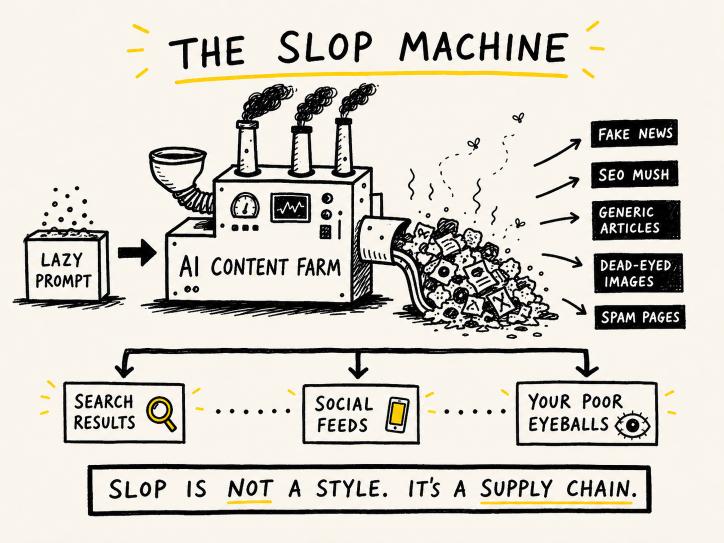
The slop machine is real.
NewsGuard says it has identified 3,749 AI content farm news and information websites across 16 languages. These are sites built to pump out large volumes of AI-generated or AI-assisted content, often with little human oversight.
That matters because slop is not just ugly.
It pollutes trust.
It fills search results.
It creates fake authority.
It makes real information harder to find.
Google saw the same problem coming through search. Its March 2024 core update targeted low-quality, unoriginal content, and Google later said that update had reduced low-quality, unoriginal content in search results by 45%. Google also introduced policies against scaled content abuse, which is basically a polite way of saying “stop mass-producing garbage and pretending it’s helpful.”
That’s the part people miss.
AI slop is not just a creative issue.
It is an information quality issue.
When everything can be generated cheaply, instantly, and endlessly, the internet starts looking like an all-you-can-eat buffet where half the trays are plastic food.
Looks edible.
Technically shaped like food.
Would not recommend putting it in your mouth.
Popular Does Not Mean Good
This is the hardest bit for creatives to swallow.
Sometimes slop wins.
Sometimes the worst thing you’ve ever seen gets shared everywhere.
Sometimes something with no craft, no taste, and no original thought outperforms the thing you spent weeks making.
That hurts.
But it does not prove your work is bad.
It proves the masses are the masses.
And the masses have always accepted slop.
They accepted cheap pop culture. Cheap politics. Cheap food. Cheap content. Cheap opinions delivered confidently by people who look like they own three microphones and one personality.
Again, McDonald’s.
McDonald’s is not fine dining.
It does not need to be.
It is convenient, consistent, cheap-ish, familiar, and everywhere.
That’s why it wins.
Not because it is the best expression of the culinary arts.
Content works the same way.
The most popular thing is often the thing that creates the least friction.
It asks the least from the audience.
It is easy to consume, easy to share, easy to understand, easy to forget.
That does not make it worthless.
But it does mean creators need to stop treating every viral piece of garbage as a personal referendum on their talent.
It is not.
Sometimes the garbage was just easier to consume.
Creativity Is Not a Popularity Contest
Creativity should start with the individual.
The maker first.
Then maybe the audience.
That sounds selfish, but it is actually the only way art works.
If you make something only because you think people will like it, you are not creating. You are guessing. You are holding a wet finger in the wind and calling it vision.
Sometimes that works commercially.
Fine.
But don’t confuse market response with creative truth.
Real creative work usually starts with something much smaller and stranger.
“I need to say this.”
“I need to make this.”
“This thing won’t leave me alone.”
“That annoyed me, so now I have to turn it into something.”
That’s where the good stuff comes from.
The itch.
The obsession.
The weird little corner of your brain that refuses to shut up.
And yes, if it connects with people, brilliant.
That’s the dream.
But if it doesn’t, that does not automatically make the work a failure.
Some work is for now.
Some work is for later.
Some work is for a small group of people who actually get it.
Some work is just for you to become the kind of person who could make the next thing.
That still counts.
The Edge Is Taste
There was a telling shift at Cannes Lions in 2026. The conversation around AI in marketing moved away from “look at this shiny toy” and toward the role of human judgement, taste, and meaningful integration. Business Insider described taste as a competitive advantage in an AI-heavy marketing world.
That is the whole game.
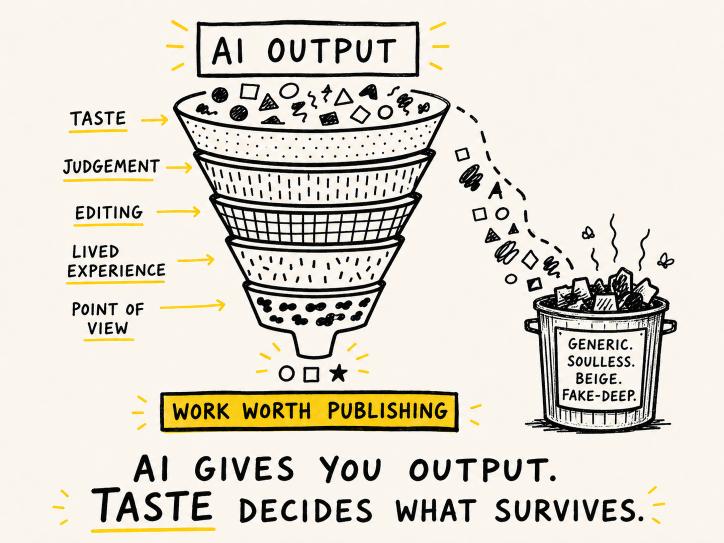
AI makes production easier.
It does not make taste easier.
In fact, it makes taste more important.
When everyone can make a half-decent image, a half-decent paragraph, a half-decent song, a half-decent logo, and a half-decent video in five minutes, half-decent becomes worthless.
The floor rises.
The ceiling does not.
The people who win are not the ones who merely use AI.
Everyone will use AI.
The people who win are the ones who know what to keep, what to cut, what to change, what to reject, and what actually deserves to exist.
That is taste.
And taste is still annoyingly human.
The Better Question
So the question is not:
“Was AI used?”
That is becoming a boring question.
The better question is:
Who was in charge?
Was AI serving the idea?
Or was the idea serving the machine?
Was there a human point of view?
Was there judgement?
Was there a reason for the thing to exist?
Did it add anything?
Did it clarify, entertain, challenge, teach, move, provoke, or make someone feel something?
Or did it simply occupy space because publishing buttons exist?
That’s the difference.
AI use is a human with a tool.
AI slop is a tool with no human taste behind it.
One can help create better work.
The other just makes more stuff.
And we are drowning in stuff.
Make the Work Anyway
So yes, there is a big difference between AI use and AI slop.
AI use can be intelligent, creative, practical, and genuinely useful.
AI slop is what happens when people confuse output with value.
More words does not mean more meaning.
More images does not mean more imagination.
More content does not mean more culture.
It might just mean more bins.
Use the tools worth using.
Ignore the moral panic from people who think using AI once means you’ve betrayed the sacred bloodline of creativity.
Also ignore the grifters pumping out 400 beige posts a week and calling themselves creators.
They are not your benchmark.
Your benchmark is whether the work says something.
Whether it carries your taste.
Whether there is a human pulse in it.
If it resonates with people, great.
If it doesn’t, that’s fine too.
The masses have always liked slop.
You make art.
Sources
- Merriam-Webster — 2025 Word of the Year: Slop
- McKinsey — The State of AI: Global Survey 2025
- HubSpot — 2026 State of Marketing Report
- Reuters Institute — Digital News Report 2025: Overview and Key Findings
- Bynder — How Consumers Interact With AI vs Human Content
- NewsGuard — Tracking AI-enabled Misinformation / AI Content Farm Tracking Center
- Google Search Central — March 2024 Core Update and Spam Policies
- Google Blog — New Ways We’re Tackling Spammy, Low-quality Content on Search
- Business Insider — In an AI World, Taste Is a Competitive Advantage for Brands