For Australians happy with modest (but still great) accommodation and everyday Japanese food, Japan can be bloody good value.
That was our experience. We weren’t booking luxury hotels or eating elaborate tasting menus. We stayed in apartment-style accommodation, used public transport and discovered that feeding a family didn’t have to produce the same financial injury it can at home.
So, is Japan expensive for Australians? It doesn’t have to be. We found everyday food much cheaper than in Australia, accommodation that suited our budget, and inexpensive city transport. A good airfare made the whole thing even better.
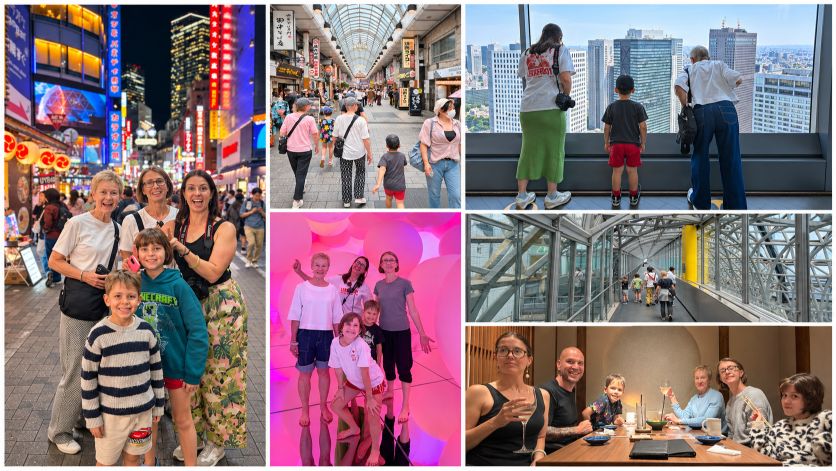
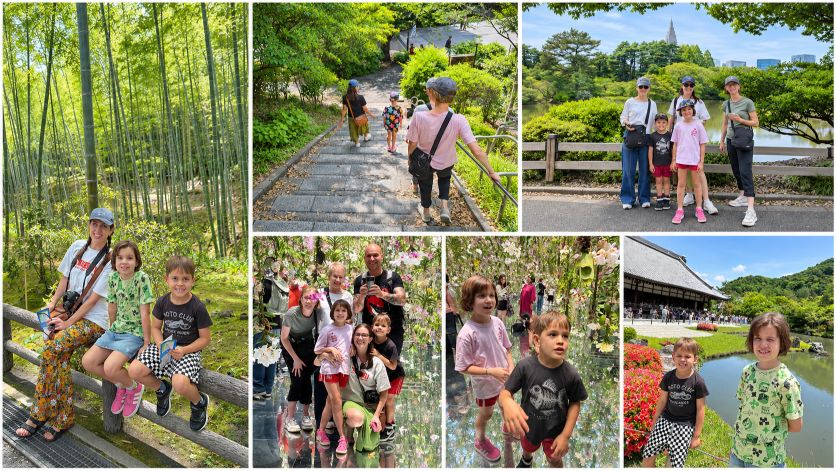
We visited in May 2026: two adults and two kids. The trip cost our family about A$10,000, including flights, accommodation, food, transport and the things we went there to do.
We’re returning in May 2027. The prices made that possible. The culture made us want to go back.
Apparently I went to Japan and accidentally signed up for an annual subscription.
Here’s how I’d think about the costs before booking yours.
What did our trip to Japan cost in AUD?
Our first trip ran from 17 May to 1 June 2026, covering Tokyo, Kyoto and Osaka. For our family of four, it came to about A$10,000 all in, or approximately A$2,500 each.
| Our May 2026 trip | Amount or detail |
|---|---|
| Our family | Two adults and two children |
| Trip dates | 17 May–1 June 2026 |
| Return flights for four | About A$1,350 |
| Total family trip cost | About A$10,000 |
| Approximate cost per person | A$2,500 |
That covered flights, accommodation, spending money and tourist activities across three major cities. An exceptionally good airfare helped, and we were happy with apartment-style accommodation rather than luxury hotels.
Those choices suited us. They also made it clear that Japan was a holiday we could afford to do again.
Flights from Australia to Japan: A$1,350 return for four was ridiculous value
Our first Japan flights cost about A$1,350 return for all four of us, through Jetstar’s Return for FREE promotion.
That’s roughly A$340 each. To Japan. And back.
I knew it was cheap when we booked. Looking at other fares puts into perspective just how good that deal was.
We used another Return for FREE offer for May 2027, this time paying A$2,200 for four, or A$550 each return. That’s a bigger bill, but still a fare I’m very happy with.
| Our Jetstar bookings | Return cost for four | Approximate cost per person |
|---|---|---|
| First trip, May 2026 | About A$1,350 | About A$340 |
| Next trip, May 2027 | A$2,200 | A$550 |
What do return flights to Japan usually cost?
There isn’t one national “normal price”. Departure airport, travel dates, airline, connections and inclusions all matter.
As a useful comparison, KAYAK’s Brisbane–Tokyo route page showed an indicative typical return range of A$1,009–A$1,737 per person when checked on 28 November 2026. That is a route-page benchmark, rather than an Australia-wide average or a quote for our dates.
An airline-direct cross-check tells a similar story: China Airlines’ Brisbane–Tokyo page advertised selected June 2027 return economy trips from A$1,225 and A$1,385. These are advertised fares for another airline, subject to availability, rather than a like-for-like quote for our Jetstar booking.
For a first planning allowance, around A$1,000–A$1,800 per person return is a reasonable range to test against actual quotes on a route such as Brisbane–Tokyo. Treat it as a starting point inferred from those checks. Peak dates and other services can cost more; sale fares can cost much less.
That’s why our roughly A$340 and A$550 return fares deserve some appreciation.
The return-free sales have come around more than once
This wasn’t an offer we saw once and spent the rest of our lives telling people about.
Jetstar advertised a Japan and South Korea Return for FREE sale in October 2026, then another for Black Friday in November. That verifies at least two separate campaigns this year.
The travel window we booked for was May–June 2027. The Japan offers I was looking at for Black Friday were for August–September instead. Jetstar’s published route-specific sale listings included Brisbane–Tokyo from 23 August to 16 September 2027.
Those are travel windows, not months when you can spend weeks deciding whether to buy. The public October sale lasted only a few days, and the Black Friday sale was scheduled to end at 11.59am AEDT on 30 November 2026, unless sold out earlier.
For context, the Black Friday announcement advertised Brisbane–Tokyo from A$599 with an eligible free return Starter fare. Four seats at that advertised minimum would be A$2,396 before extras, if all four were available at that price.
“Return for free” means an eligible return Starter fare with a purchased outbound Starter fare. It doesn’t make checked baggage, seat selection and meals free. Compare the final booking total.
Has fuel pushed prices up?
There is evidence for the broader point. In its FY26 results, Qantas Group said it adjusted fares and capacity in response to higher fuel prices.
That supports saying fuel costs have put upward pressure on fares. It doesn’t tell us how much of the difference between our two bookings came from fuel, rather than dates, demand, available sale seats or other booking differences.
The practical lesson is to watch for repeat sales, understand the travel windows and price your whole family before booking accommodation around a headline fare.
A cheap departure from Sydney isn’t automatically a bargain if you need to get the family to Sydney first.
Accommodation in Japan: affordable places we’re happy to stay in
Japan has accommodation at plenty of price points, from basic rooms to hotels that presumably send someone to admire your luggage.
Australia does too. The comparison that matters to us is what we can get at the affordable end, because that’s where we’re happy to book.
We’ve used more Airbnb-style apartments and holiday rentals than high-end hotels. We want somewhere comfortable, practical and well located. We don’t need a lobby with its own fragrance.
For our next trip, we’ve locked in 21 nights averaging about A$220 per night for the four of us. Using that rounded average, accommodation comes to roughly A$4,620, or around A$55 per person per night.
That’s our booking result across the itinerary, rather than a claim that every Japanese family apartment costs A$220. But it is an actual example of the kind of accommodation budget we’re happy with.
Add our A$2,200 flights and those two major costs come to roughly A$6,820 for the family, before food, trains, attractions, insurance and other spending. That is why I see value in the next trip, even with the dearer flights.
Our first trip was more expensive for accommodation because we needed places that slept six. Those were harder to find, and the smaller choice pushed the nightly cost up.
It’s a useful reminder that adding people doesn’t automatically make a booking cheaper per person. Sometimes it pushes you into a much smaller pool of suitable properties.
For a family of four, look at the actual beds, room capacity, station access, cleaning charges and any separately payable local taxes. A cheap room advertised for two adults tells you very little until you enter everyone travelling.
Laundry and kitchen facilities can also make an apartment useful beyond its nightly rate. Breakfast doesn’t have to involve getting four people dressed and out the door.
And check meals with traditional accommodation. JNTO’s budget advice notes that a room-only booking may be less practical where nearby eating options are limited.
Our own experience is that Japan gives us accommodation we’re happy to use at a price we’re happy to pay. That is a more useful comparison than matching a luxury Tokyo hotel against an Australian campsite.
Food in Japan: everyday eating was WAY cheaper than Australia
This was one of the clearest differences for us.
Everyday, entry-level food was way cheaper than what we’re used to paying in Australia. Feeding ourselves on a budget was easy.
I’m talking about ordinary meals and the food you buy while getting on with your day. You can spend whatever you like on fancy sushi. That doesn’t tell a family much about the cost of lunch.
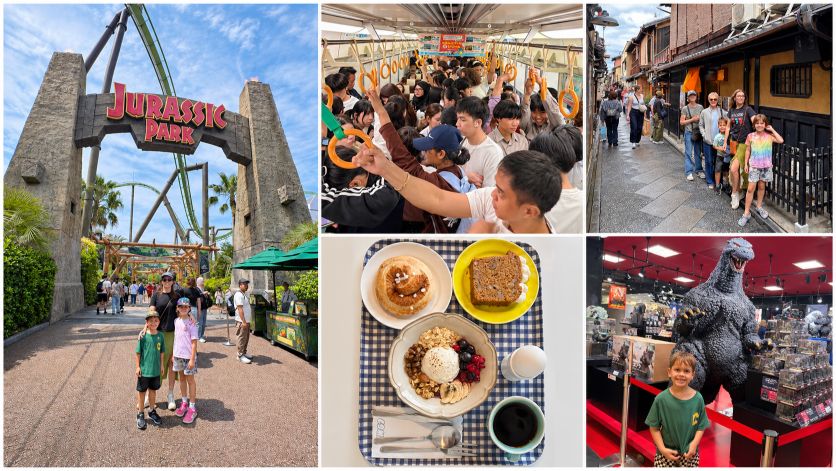
At first, I thought the convenience stores were the answer. Places such as 7-Eleven made grabbing food easy and affordable.
Then I discovered actual supermarkets.
That took the food budget down another notch. The convenience stores had felt cheap; the supermarkets showed me what I was paying for the convenience.
I wouldn’t claim every item in every Japanese supermarket is cheaper than its Australian equivalent. I would absolutely say that, for the everyday food we were buying, eating affordably was easier than Japan’s expensive reputation had led me to expect.
With apartment-style accommodation, that becomes especially useful. You can buy breakfast, drinks, snacks and simple meals without making every hungry child a restaurant booking.
There’s still plenty of room for eating out. JNTO recommends lunchtime specials and family restaurants as ways to control spending, which fits the broader point: you have options beyond expensive restaurants.
My approach would be supermarket basics, convenience-store food when it’s convenient, and proper meals out because we’re in Japan and want to enjoy the food.
Children will still announce that they’re starving eight minutes after lunch. I’m yet to find a country that fixes that.
In the worked budget below, I’ve allowed A$130 a day for the four of us. That is an illustrative allowance for a mix of meals and snacks, rather than the minimum you need to spend or an itemised average from our first trip. You can aim lower with more supermarket meals, or spend more on restaurants.
Public transport, shinkansen tickets and the JR Pass
Separate local transport from travel between cities.
They behave very differently in a budget.
Tokyo Metro’s regular adult paper-ticket fares currently run from ¥180 to ¥330, apart from specified special intervals. At the simple budgeting rate of ¥100 to A$1, that is about A$1.80–A$3.30 for a ride on that operator.
That doesn’t cover every railway, every transfer or the airport. It does show why an ordinary city journey and a bullet train across the country belong on separate lines in your spreadsheet.
Long distances cost money. More cities mean more transport, more transfers and less time doing whatever made you want to go in the first place.
Before adding another stop, price the journey for everyone and look at the time it consumes.
Suica made everyday transport easy, with one odd cash requirement
We used Suica cards for getting around and I’d happily recommend that approach.
Load money onto the card, tap through the gates on supported services and get on with your day. JR East explains that Suica deducts the fare from your balance, so you don’t need to buy an individual ticket for every ordinary journey.
The odd bit was topping up the physical cards at the machines we used. They needed cash. I couldn’t just tap my bank card and add money.
Japan could move us around its enormous cities with remarkable efficiency, but first I needed to find some banknotes to feed a machine.
Useful to know before you run the balance down.
There is an important distinction for anyone planning now: physical cards and mobile Suica have different top-up options. JR East’s visitor guidance describes cash top-ups for physical cards; its Apple Pay Suica guidance explains that you can add money in Wallet by credit card. A supported device and payment card are required.
Suica is a prepaid payment tool, rather than an unlimited-travel pass. It won’t replace the separate tickets or reservations you may need for long-distance shinkansen journeys.
Does a Japan Rail Pass save money?
Sometimes. Calculate it.
The official Japan Rail Pass price page currently lists a seven-day Ordinary pass bought online at ¥50,000 per adult and ¥25,000 per child. A 14-day version is ¥80,000 and ¥40,000 respectively. Overseas agency prices are higher.
For two adults and two eligible children, that makes the online 14-day pass ¥240,000, or A$2,400 at our illustrative ¥100 budgeting rate.
Our current 2027 estimate for all planned transport is approximately A$1,753–A$2,312. That is a planning estimate, but it gives us a clear reason to price individual journeys before buying a nationwide pass.
Check which JR trains are covered, the consecutive validity period, and additional ticket requirements for Nozomi or Mizuho services.
A pass can be useful. Owning one isn’t a compulsory stage of becoming a person who has been to Japan.
Theme parks, cultural experiences and day trips
A day wandering a neighbourhood and a day at a major theme park should not share the same spending assumption.
For our 2027 planning, attraction entry totals approximately A$1,172–A$1,395 for the family. Those are estimates, not purchased tickets or guaranteed May 2027 prices, and they exclude USJ Express passes.
That is already a meaningful amount before food, merchandise and getting there.
Choose the experiences you care about, then price the complete day: admission, optional upgrades, transport and likely extras.
A day trip towards Mount Fuji might involve several transport legs and paid activities. A slower day exploring a neighbourhood might cost little beyond meals and local fares. Both can belong in a good holiday.
JNTO notes that many temples, shrines and parks offer free or inexpensive visits. Check individual sites: free grounds don’t necessarily mean every garden, building or exhibition is included.
You don’t need a ticket scanner to validate every day of your holiday.
A Japan travel budget for a family of four
Here is a worked example for two adults and two children travelling for 14 days and 13 nights.
These are deliberately chosen planning allowances. The airfare assumes A$1,100 per person return, within the indicative Brisbane–Tokyo benchmark above. These are sample allowances, not current booking quotes or the costs of our own trip. Replace them with prices for your own dates.
| Cost category | Illustrative allowance |
|---|---|
| Return flights for four | A$4,400 |
| Accommodation: 13 nights at A$220 | A$2,860 |
| Food: 14 days at A$130 for the family | A$1,820 |
| Local transport: 14 days at A$25 | A$350 |
| Sightseeing: 14 days at A$40, averaged across the trip | A$560 |
| Intercity trains and airport transfers | A$900 |
| Travel insurance | A$250 |
| Subtotal | A$11,140 |
| Contingency: 10% | A$1,114 |
| Illustrative total | A$12,254 |
The everyday allowance for food, local transport and sightseeing works out at A$195 per family per day. Accommodation, flights and major transport sit outside it.
That distinction matters when someone says, “You only need a hundred dollars a day.” Per person? Per family? With a room? Before trains?
The example also leaves out shopping, mobile data, Australian airport parking, separately charged accommodation taxes and premium attraction upgrades. Add them where relevant. Check that an A$560 sightseeing allowance actually covers your wish list before adopting it; multiple theme parks can change that line quickly.
Solo travellers need their own calculation. They cannot necessarily divide a private room or taxi bill four ways. Equally, budget travellers using hostels will build a different trip from a family booking private accommodation.
The AUD–yen exchange rate changes your buying power
Japanese yen prices and Australian dollar costs are two separate moving parts.
The Reserve Bank of Australia reported ¥106.10 per A$1 on 27 November 2026. That is a reference rate, not a guaranteed rate from your bank or travel card.
I’ve used ¥100 per A$1 for the illustrative conversions here and in our 2027 planning. It keeps the arithmetic easy and leaves some room compared with that reference rate. It cannot protect the budget against every future currency movement.
Here is how a fixed ¥100,000 expense changes:
| Exchange rate | Cost of ¥100,000 in AUD, before fees |
|---|---|
| ¥90 per A$1 | A$1,111 |
| ¥100 per A$1 | A$1,000 |
| ¥110 per A$1 | A$909 |
Use the yen amount when comparing Japanese prices. Use the rate you can actually obtain when working out what leaves your Australian account.
For travel money, compare conversion margins, foreign transaction fees and ATM charges. If a payment terminal offers conversion into AUD, inspect the rate and charges rather than assuming the familiar currency gives you a better deal.
You don’t need to become a currency trader. You do need to know what your card charges.
Best time to visit Japan for your budget
The best time to visit Japan depends on what you want to do and which dates you can afford.
Cherry blossom season in spring, ski resorts in winter, Australian school holidays and Japanese domestic holidays can all change the prices available for your particular route. Compare dated quotes rather than relying on one blanket “cheap month” rule.
May needs a special mention because that’s when we travel.
JNTO identifies late April and early May’s Golden Week as a particularly busy travel period, with the second half of May generally calmer.
Our first visit began on 17 May 2026. Our return begins on 2 May 2027, so it overlaps the busier period.
Those are different booking conditions. I’m not going to pretend that writing “May” on both itineraries makes the prices interchangeable.
If your dates are flexible, compare the full flight-and-accommodation total across several windows. A saving on the airfare can disappear in the room bill.
Tax-free shopping changed after our first visit
There is a practical change for anyone travelling after our May 2026 trip.
For purchases from 1 November 2026, Japan Customs describes a refund system: eligible visitors pay the tax-inclusive amount at participating shops, then receive the applicable tax refund after completing the departure customs confirmation process.
Eligible purchases generally need to total at least ¥5,000 before tax at one store on one day. The goods must leave Japan, and departure confirmation must be completed within 90 days of purchase.
Read the current process before shopping and allow time before checking in luggage containing the goods.
For your budget, the immediate point is simple: you need enough money to pay the tax-inclusive price first.
And buying something you didn’t want because it qualifies for a refund remains an excellent way to spend money.
Is Japan cheaper than an Australian holiday?
It can be. Compare the actual holidays.
I previously looked for a short stay in Yamba and couldn’t find suitable accommodation for less than A$600 a night for the dates I was searching.
Two nights at that price came close to our unusually cheap Japan airfare for four.
That made me stop and think. It did not establish that every Yamba property costs A$600, or that an entire Japan holiday costs the same as a local weekend.
Compare room capacity, dates, meals, transport and activities. Include the Australian holiday you would realistically book, whether that’s a caravan trip, an apartment or a resort.
On the practical side, Japan gave us a holiday we could afford, with food, accommodation and transport that worked for our family. But the reason I wanted to return went well beyond what we paid.
The real value of Japan was how it made me feel
The service, the cleanliness, the order and the consideration people showed in public all stayed with me.
I loved the quiet on trains. People queuing. The sense that being in a shared space came with some responsibility towards everyone else using it. Those ordinary interactions became a big part of what I enjoyed about being there.
I’d gone for a family holiday and found myself becoming completely enamoured with the country and its culture.
Enough that I started looking at what it would cost to buy a home. How could I work there? What would it take to get permanent residence?
Some people come home and look through their photos. I apparently needed to investigate immigration.
My wife, Annie, suggested we go on another holiday first.
Fair. I’d managed to turn one family trip into a potential international relocation.
That’s why the value question means more to me than cheap flights and affordable lunches. We enjoyed the places we visited, but I also wanted more time with the everyday life around them: the streets, the shops, the service and the way people treated each other.
The budget tells me whether we can go back. That feeling is why I want to.
Questions Australian travellers ask about Japan costs
Is Japan expensive for Australians visiting for the first time?
For our family, it was excellent value. Our May 2026 trip cost about A$10,000 for the four of us, helped by a return-free airfare sale. We found everyday food much cheaper than at home and used apartment-style accommodation. Price your own dates, room needs and activities before adopting our total.
How much AUD per day should I budget?
Separate daily spending from major bookings. In the illustrative family example above, food, local transport and sightseeing total A$195 per day for four. Accommodation, flights, intercity transport, insurance and the listed extras must be added.
Is the cost of living in Japan a useful holiday guide?
Only partly. A resident’s rent and groceries don’t tell you what a visitor will pay for short-stay accommodation, attraction tickets and shinkansen journeys. Build a travel budget around the trip you intend to take.
What costs are easy to overlook?
Airport transfers, baggage, accommodation taxes, insurance, eSIMs, laundry, luggage storage and attraction upgrades can all need their own allowance. Smartraveller’s Japan advice is also worth checking when choosing insurance for the activities you plan.
So, is Japan expensive for Australians?
For the way we travel, Japan offered excellent value. About A$10,000 took our family of four through Tokyo, Kyoto and Osaka, and we came home wanting to return.
A good flight deal helps. So does choosing accommodation you’re comfortable with and discovering that supermarkets exist beyond the nearest 7-Eleven.
Price the holiday you actually want. Include the trains, the activities and some room for the unexpected. You might find Japan is much more achievable than its expensive reputation suggests.
We’ve already booked the next trip.
Annie said another holiday first. I heard “first”.