Conformity means adjusting what you say, do or believe to match other people. Groupthink happens when a group’s desire for agreement crowds out proper scrutiny of a decision.
Laughing at the boss’s terrible joke is conformity. Helping wave through their terrible proposal because nobody wants to question it illustrates the danger of groupthink.
Both involve social influence. The difference is what happens to your judgement, and what happens to the group’s decision-making process.
Groupthink and conformity: the difference at a glance
| Question | Conformity | Groupthink |
|---|---|---|
| What does it concern? | A person adjusting to other people | A group’s approach to making a decision |
| What drives it? | Wanting acceptance or trusting others’ judgement | Agreement takes priority over critical evaluation |
| Does it require a shared decision? | No | It concerns collective decision-making |
| Is it necessarily harmful? | No; shared norms can help people cooperate | It describes impaired scrutiny of decisions |
| Everyday illustration | Copying your colleagues’ dress style | A team sidelines objections to its preferred plan |
Conformity can contribute to groupthink, but it does not automatically produce it. One person following a group gives you less information than examining how that group handles questions, evidence and alternatives. OpenStax’s overview of social influence provides a useful starting point.
What is conformity, and why do people conform?
Group members can conform publicly without changing their private beliefs. You might tell your friends you enjoyed a film because you cannot face another forty minutes of explaining yourself. You still think the film was rubbish. Your stated opinion has changed; your judgement has survived.
Other times, people genuinely adopt the group’s view.
Social psychology distinguishes two familiar influences:
- Normative social influence: wanting acceptance or avoiding disapproval.
- Informational social influence: treating other people’s judgements as evidence, particularly when you are uncertain.
Morton Deutsch explained this distinction when reflecting on his research with Harold Gerard. The same outward agreement can have different reasons behind it.
Imagine choosing a restaurant. You might follow your friends because you trust their local knowledge. Or you might go along because disagreeing with the designated dinner dictator turns choosing noodles into a constitutional crisis.
You end up at the same table. What got you there matters.

What Asch’s conformity experiments showed
In Solomon Asch’s 1955 account, participants judged line lengths while other people, working with the researcher, deliberately gave matching wrong answers.
Across the critical trials in the reported series, participants followed the incorrect majority on 36.8% of judgements. About a quarter never did. Introducing a truthful partner substantially reduced conformity.
The experiment demonstrated pressure alongside resistance. It involved male college students performing a particular laboratory task, so that percentage is no universal measure of human suggestibility.
My practical reading: telling people to think independently is more convincing when they can see that disagreement is survivable.
What is groupthink?
Psychologist Irving Janis developed the influential groupthink theory around agreement displacing realistic consideration of alternatives. His 1971 article examined decisions surrounding the Bay of Pigs invasion, the attack on Pearl Harbor and escalation of the Vietnam War.
Those were historical interpretations, rather than controlled demonstrations that one mechanism explained each disaster.
For an everyday illustration, imagine a team choosing a new booking system. The supplier gives a brilliant presentation. The senior leader loves it. Everyone wants the project moving.
Someone asks whether it integrates with the existing software.
“We’ll work through that.”
Someone else asks about migration costs.
“Let’s stay focused on the opportunity.”
By the end, the proposal has unanimous support. The unanswered questions have apparently joined another department.
The risk is premature consensus: settling on an answer before examining it properly. The warning is how objections disappear from the decision-making process.
The symptoms of groupthink
Janis described eight characteristics of groupthink:
- Illusions of invulnerability: confidence makes warnings seem unimportant.
- Collective rationalisation: members explain away conflicting evidence.
- Assumed morality: the group’s goodness excuses scrutiny of its actions.
- Stereotyping outsiders: critics are dismissed as incapable or malicious.
- Direct pressure to conform: dissent attracts disapproval.
- Self-censorship: members withhold their doubts.
- Illusion of unanimity: silence is counted as agreement.
- Mindguards: members shield the group from unwelcome information.
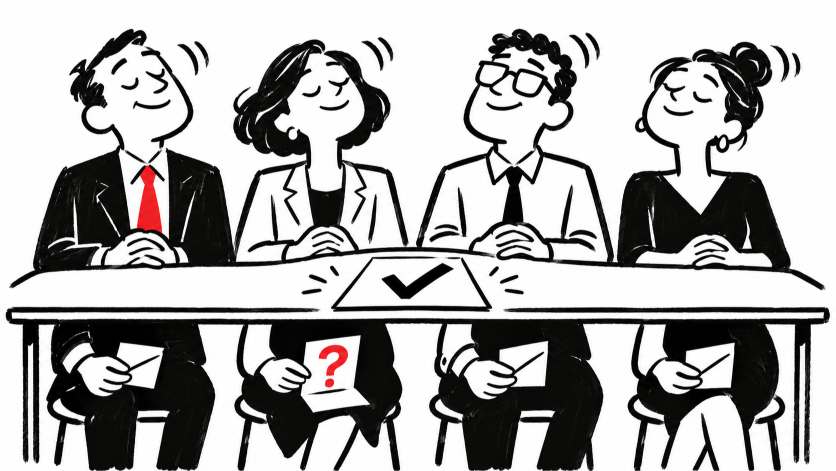
These are prompts for examining a process. Spotting one familiar behaviour does not diagnose an entire organisation.
How strong is the evidence for groupthink theory?
The theory has mixed empirical support. That matters when the label gets used to explain every collective cock-up.
In Won-Woo Park’s 2000 study, involving 64 four-person groups, Janis’s predictions received only partial support.
A close team or a bad decision alone does not prove groupthink. Sometimes the information was incomplete. Sometimes the incentives were rotten. Sometimes the plan was just badly designed.
Calling everything groupthink can become its own way of avoiding critical thinking. You have named the villain, so apparently the investigation is over.
I find the concept most useful when it prompts specific questions: which alternatives were examined, whose information was missing, and what happened when someone objected?
Can group conformity improve group performance?
Yes. Consider a team where everyone is expected to check the figures, declare uncertainties and question assumptions. Following those group norms means participating in scrutiny.
Deutsch also emphasised that norms can support independent judgement. Conforming to a culture of questioning can therefore help protect it.
That is why “stop conforming” is such incomplete advice. What are you being asked to conform to?
A team that rewards honest corrections creates a different expectation from one that rewards enthusiastic nodding. Both have a culture. Only one gives the spreadsheet a fighting chance.
An everyday example: the holiday everyone agreed to
Imagine friends planning a holiday. One wants a packed itinerary. Others prefer a slower pace but agree because they do not want to seem difficult. That illustrates conformity.
Now imagine the group dismissing warnings about travel times, ignoring the budget and treating every practical concern as spoiling the excitement. The decision process starts resembling groupthink.
Agreement itself tells you very little. Ask whether the concerns received a fair hearing, and whether the plan could change in response.
How is group polarisation different?
Group polarisation describes a shift towards a stronger version of a group’s initial leaning after discussion. OpenStax explains the distinction here.
Friends who are mildly enthusiastic about an investment might talk one another into much greater enthusiasm. To assess groupthink, you would need to examine how they evaluated the decision, including contrary evidence.
More confidence does not tell you whether they became better informed.
How to avoid groupthink without making every meeting unbearable
Make disagreement useful and reasonably safe. Endless argument is no more impressive than instant consensus. Someone still has to make the decision.
These safeguards offer a practical starting point.
Collect individual views first
Before the discussion, ask each person to write down their recommendation, main concern and missing information. Collect the answers before circulating them.
You now have a record of what people thought before hearing everyone else. Explore the differences.
For the booking system, ask: “What would stop you approving this supplier today?” That gives concerns somewhere to go before enthusiasm takes over.

Let the leader explain their preference later
Hear the others’ assessments first, then invite the leader’s view. Give the information a hearing before rank starts doing some of the persuading.
Private responses, outside input and delaying a leader’s position statement also feature among the decision safeguards outlined by OpenStax.
Give real dissent somewhere to go
A devil’s advocate can create a place for objections, but make room for people’s actual concerns too.
In a 2001 study by Charlan Nemeth and colleagues, authentic dissent stimulated more original thought and consideration of the opposing position than assigned devil’s advocacy. That supports welcoming genuine disagreement, while leaving room for different results in different settings.
Record the concern. Investigate it. Explain what you found.
“Thanks for sharing” is a polite sentence. It is also an excellent place to bury a concern if nothing happens afterwards.
Invite someone who can challenge the assumptions
For the software purchase, that might mean an integration specialist, a frontline user or someone who managed a similar migration.
Ask specific questions. Can the integration work? Which costs have we missed? What makes this timeline unrealistic?
Seek relevant information from outside the group, with permission to complicate the preferred story.
Decide what would trigger a rethink
Write down the conditions for reviewing the group’s decision. Perhaps a failed integration test pauses procurement. Perhaps costs above an agreed amount require a fresh assessment.
Set a review date and name the person responsible. Changing your mind now has a legitimate place in the plan, before the consequences become impossible to explain away.
When disagreement becomes disloyalty
The question that interests me most is what happens to your standing in a group when you challenge something it wants to believe.
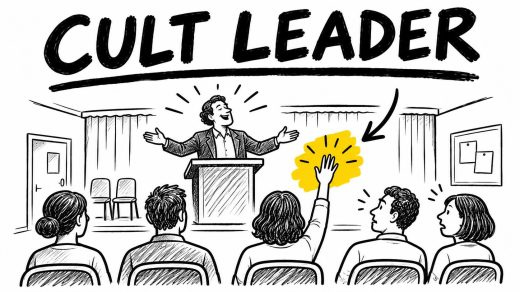
In my book, You’re in a Cult, I explore what happens when questioning an idea starts being treated as betraying the people who believe it. Suddenly, you are defending your loyalty instead of discussing whether the idea makes sense.
Sharing beliefs does not make a community a literal cult. The useful thing to examine is what happens when those beliefs are questioned.
Try asking your own group one reasonable question about something it takes for granted. Be specific. Give people a fair chance to answer. Stay willing to discover that you were wrong.
Then pay attention.
Can they explain the reasoning? Examine the evidence? Admit an uncertainty? Can you disagree and still belong?
You might end up agreeing with them. Good. Agreement reached through scrutiny is something worth having.
If belonging requires you to stop asking questions, read the membership terms again.