SEO is not just rankings. CRO is not just conversion rate. Analytics is not just dashboards. The work evolved. The names didn’t.
Some digital marketing terms have aged like milk in a hot car.
They made sense once.
Then the work evolved.
The names did not.
And now we are stuck using old labels to describe jobs that have become much bigger, messier, and more commercially important than the names suggest.
That matters more than people think.
Because names shape understanding. Understanding shapes budget. Budget shapes hiring. Hiring shapes execution. And execution shapes whether the business actually gets better, or just has a very pretty dashboard telling everyone where the fire is.
The problem with a lot of legacy digital terms is that they describe the old container, not the current job.
SEO is not just rankings.
CRO is not just conversion rate.
Analytics is not just reporting.
But those are still the mental shortcuts many senior people use. And when the name makes the work sound small, the investment usually follows.
The Old Labels Are Too Small Now
Digital used to be easier to split into neat little buckets.
SEO got traffic. Paid media bought traffic. CRO improved conversion rate. Analytics reported what happened. UX made things usable. Content filled the blog.
Everyone had their lane. Everyone had their acronym. Everyone could pretend the customer politely moved through the business in the same order as the org chart.
Adorable.
But that is not how people behave.
Customers search, compare, skim, doubt, trust, bounce, return, ask AI, check Reddit, watch YouTube, read reviews, open twenty tabs, forget what they were doing, come back three days later, and then buy from whoever made the decision feel easiest.
That messy reality does not fit neatly inside old labels.
And that is where the problem starts.
The terms are not just outdated. They are limiting.
They make broad commercial functions sound like small technical tasks. They make strategic work sound tactical. They make senior people think they understand the job when they only understand the label.
That is dangerous.
Because if the business misunderstands the work, it will underfund it, under-resource it, mismeasure it, and then act surprised when the results are average.
Amazing mystery. Call Scooby-Doo.
1. SEO Is Not Just Rankings
SEO might be the cleanest example of a digital term that no longer fully explains the job.
Once upon a time, SEO was easy enough to describe.
Rank higher in Google. Get more organic clicks. Make sure the title tag is not a complete crime scene.
Simple. Useful. True enough.
But that version of SEO belongs to a much simpler web.
Today, even the click is not guaranteed.
SparkToro reported that in the first four months of 2026, 68.01% of Google searches ended without a click. That is not a small behavioural shift. That is Google becoming less of a traffic referral machine and more of an answer machine with ads attached. Lovely for Google. Less lovely for everyone building the open web.
Search Engine Land covered the same SparkToro research and reported that zero-click behaviour had increased from 60.45% in 2024 to 68.01% in early 2026. So even when search demand exists, the click is becoming less reliable as the end reward.
That does not mean SEO is dead.
That line should be legally banned from marketing conferences.
It means the job has changed.
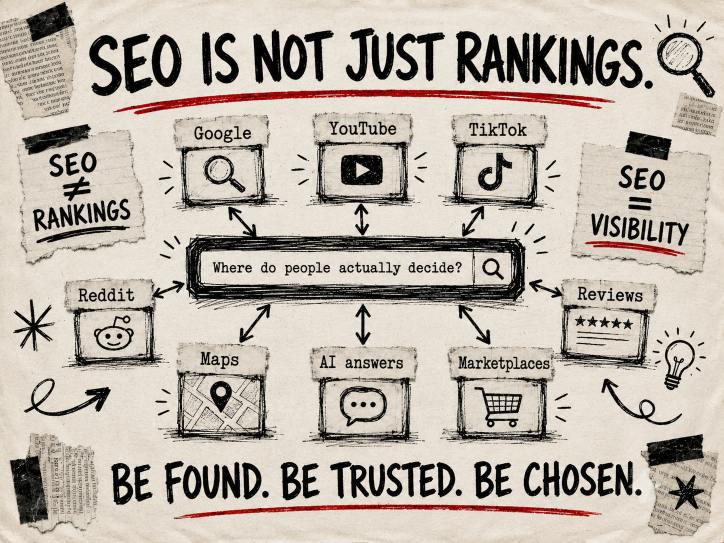
People do not only discover brands through ten blue links on Google anymore.
They search on Google. They search on YouTube. They search on TikTok. They search on Reddit. They search on Amazon. They search on maps. They search inside AI tools. They read reviews. They compare snippets. They look for proof from strangers before they believe anything you say about yourself.
People are not just searching for websites. They are searching for confidence.
And this is where the old idea of SEO starts to feel too small.
When many people hear SEO, they still think: keywords, rankings, metadata, backlinks, blog posts, and maybe technical SEO if someone in the meeting wants to sound dangerous.
But the real job is bigger.
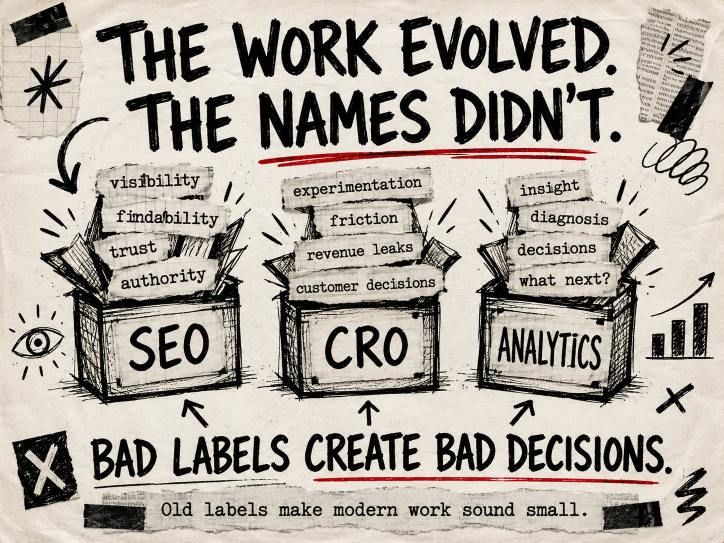
SEO is visibility, findability, trust, authority, relevance, demand capture and brand presence across the places people actually make decisions.
AI search makes this even messier. A 2026 academic study measuring Google AI Overviews found that AI Overviews appeared for 13.7% of trending queries overall, rising to 64.7% for question-form queries. It also found that nearly 30% of AI Overview-cited domains did not appear in the traditional first-page results, which suggests AI source selection is not just classic ranking with a different hat on. Source: arXiv study.
That is a big deal.
Because it means SEO is no longer just about ranking pages in the usual way.
It is about becoming the kind of source that search systems, answer engines, and customers recognise as credible enough to surface.
That includes technical structure, content quality, brand signals, expertise, internal linking, information architecture, reviews, reputation, user experience, commercial relevance, and yes, all the boring foundational stuff people love to skip before asking why their traffic fell off a cliff.
SEO has become less of a channel and more of a visibility system.
But the name still makes it sound like keywords for Google.
That is the problem.
Because if the CEO thinks SEO means keywords, they will fund keywords. If they understand SEO as organic visibility and demand capture, they are far more likely to fund the actual work required.
Big difference.
One gets you a content calendar full of dead-eyed blog posts. The other builds a system that helps the business get found and chosen.
2. CRO Is Not Just Conversion Rate
Conversion Rate Optimisation might be the worst-named important function in ecommerce.
It sounds like the job is to stare lovingly at a percentage until it goes up.
Like some poor bastard is sitting in a dark room whispering sweet nothings to a dashboard.
Come on, 2.1%. You can be 2.2%. I believe in you.
That is not the work. Or at least, it should not be.
The term CRO makes people think about button colours, form tweaks, checkout tests and minor page polishing.
Make the CTA green. Move the trust badge. Shorten the form. Change Buy Now to Add to Cart and wait for the angels to sing.
Sometimes those things matter. Often they do not.
The real work is much deeper.
CRO is commercial experimentation.
It is figuring out why people hesitate. Why they leave. Why they do not trust the offer. Why they compare and do not come back. Why they add to cart and disappear like someone who said they were just five minutes away half an hour ago.
It is about friction, motivation, trust, pricing, merchandising, UX, offer clarity, checkout confidence, product discovery, customer intent, operational reality and commercial quality.
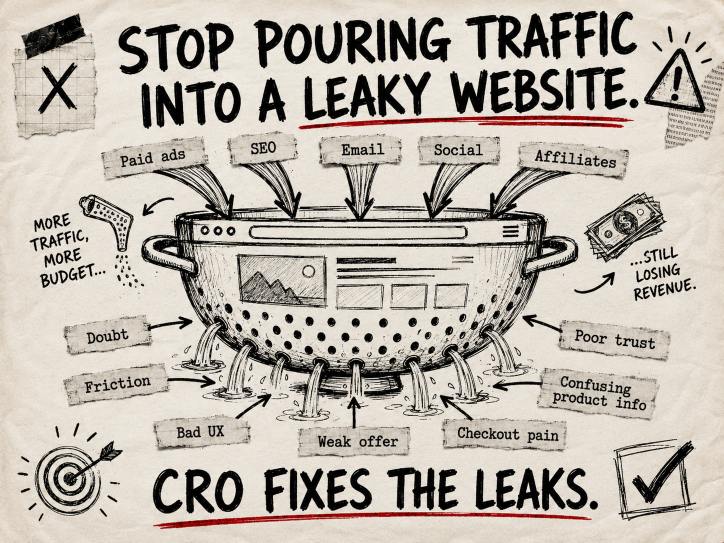
And this matters because ecommerce is already a leaky machine.
Shopify says global ecommerce conversion rates commonly sit around 2% to 3%, depending on industry, price point, device mix and traffic quality.
Baymard Institute has tracked the global average cart abandonment rate for 14 years and currently puts it at about 70%. In plain English: lots of people get close to buying, then leave. That is not a tiny leak. That is a very expensive colander.
Contentsquare’s 2025 Digital Experience Benchmarks reported that brands spent 13.2% more on digital advertising, the cost of an online visit rose 9% year on year and 19% over two years, while conversion rates dropped 6.1% year on year. That is basically the CRO argument wearing a high-vis vest and screaming from the side of the road.
Traffic is getting more expensive. Users are getting harder to convert. Websites are still leaking money.
And yet CRO is often treated like a nice little side project for changing button colours.
Madness.
Now add the maths.
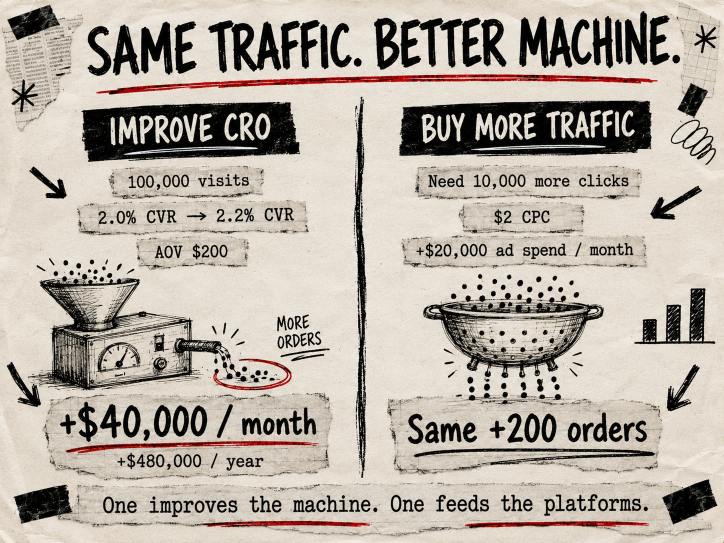
Say an ecommerce site gets 100,000 visitors a month. Its conversion rate is 2%. Its average order value is $200.
That produces 2,000 orders a month and $400,000 revenue a month.
Now improve conversion rate from 2.0% to 2.2%. That sounds tiny. It is not. That is a 10% improvement in conversion performance.
Now the site gets 2,200 orders a month and $440,000 revenue a month.
That tiny 0.2 percentage point lift is worth $40,000 extra revenue per month, or $480,000 extra revenue per year, from the same traffic.
Now compare that to acquisition.
To get the same 200 extra orders at the original 2% conversion rate, you would need another 10,000 clicks per month. At a $2 cost per click, that is $20,000 extra ad spend per month, or $240,000 extra ad spend per year.
Same revenue lift.
But one option improves the machine. The other keeps feeding Google and Meta like two very rich seagulls at a chip shop.
That is why CRO matters.
Not because conversion rate is the only metric.
But because the practice behind CRO is one of the biggest levers in digital.
The name just does a terrible job of explaining it.
And here is the bit that really gets misunderstood: the goal is not always to increase conversion rate.
Sometimes the best commercial decision lowers conversion rate.
That sounds wrong if the only thing you care about is the metric. But it makes complete sense if you care about the business.
You might reduce low-quality discount traffic. Conversion rate may drop. Margin may improve. Customer service pressure may fall. Returns may decrease. Revenue quality may improve. The business may become healthier.
But if the entire practice is named after conversion rate, someone will look at the dashboard and say, The test failed.
No, mate. Your understanding failed.
Conversion rate is useful. But it is not the business.
A higher conversion rate with worse customers, lower margin, more returns, and more operational pain is not always a win.
This is why CRO is such a misleading term. It names the metric, not the mission.
The mission is to make the business better at turning attention into commercial value.
That value might show up in conversion rate. It might show up in average order value. It might show up in revenue per visitor. It might show up in lead quality. It might show up in fewer abandoned checkouts. It might show up in better product discovery. It might show up in higher margin. It might show up in fewer bad-fit customers.
That is not conversion rate optimisation. That is revenue leak repair. That is customer decision improvement. That is commercial experimentation. That is making the website do its bloody job.
3. Analytics Is Not Just Dashboards
Analytics is another term that sounds smaller than the work.
Most people hear analytics and think reports, dashboards, charts, traffic, revenue, conversion rate, and maybe a line graph with a suspicious spike that no one can explain but everyone agrees looks important.
The problem is that reporting what happened is not the same as understanding what happened.
And understanding what happened is not the same as knowing what to do next.
A dashboard is not insight. A chart is not strategy. A report is not a decision.
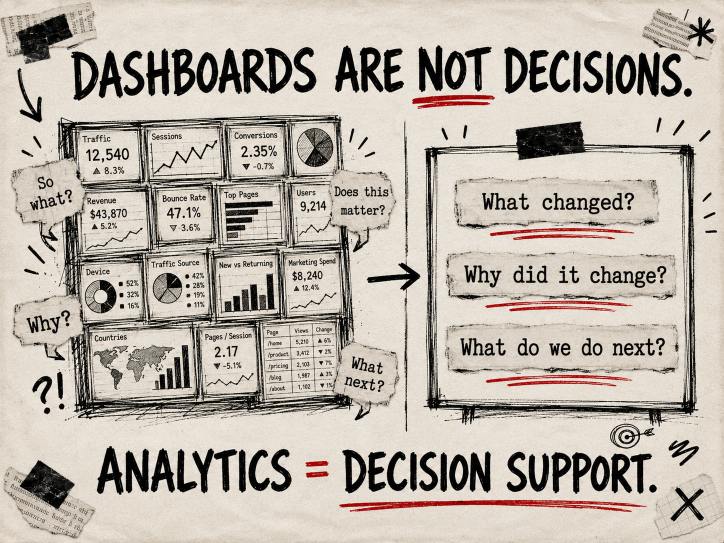
Most businesses do not have a shortage of dashboards.
They have a shortage of people asking good questions.
What changed? Why did it change? Does it matter? Was it seasonality? Was it tracking? Was it traffic mix? Was it pricing? Was it availability? Was it a campaign? Was it a competitor? Was it one product carrying the whole number while everything else quietly fell over?
Analytics should become decision support. Not reporting theatre.
Not here are the numbers. Not traffic was up 4% and revenue was down 2% followed by everyone nodding like a group of confused pigeons.
The real value of analytics is helping the business understand what matters and what to do about it.
And that matters even more because digital data is getting bigger, noisier, and easier to misread.
Contentsquare’s 2026 Digital Experience Benchmark Report is built from 99 billion sessions across 6,500+ websites and 22 million customer service interactions. That gives you a sense of the scale of modern digital behaviour. The issue is not that businesses lack data. The issue is that data does not magically become insight just because someone put it in a dashboard.
IBM defines data-driven decision-making as using data and analysis instead of intuition to inform business decisions. Which sounds obvious, because it is. But plenty of businesses still use data like a drunk bloke uses a streetlight: for support, not illumination.
Real analytics should reveal the shape of the problem. It should separate signal from noise. It should stop averages from lying.
Because averages lie all the time.
Average conversion rate can hide a mobile problem. Average order value can hide a product mix problem. Average revenue can hide a margin problem. Average traffic can hide a channel quality problem.
Average customer performance can hide the fact that one segment is doing all the heavy lifting while another is burning money in the car park.
Analytics should make the business smarter. Not just better informed.
Better informed means you know the number. Smarter means you know what the number means and what to do next.
That is why analytics can be such a weak label. It makes the job sound like measurement.
The real job is interpretation. Decision intelligence. Commercial diagnosis. Helping the business stop lying to itself with tidy charts and comforting averages.
Data is only useful if it changes behaviour.
Otherwise, it is just decoration for meetings.
And there is already enough decoration in meetings. Usually in the form of 48-slide decks that should have been an email and an existential crisis.
The Data Backs the Point
This is not just a terminology rant.
Although, to be fair, it is partly that.
The data tells the same story.
Search is changing. Clicks are less guaranteed. AI answers are changing how sources are surfaced. Ecommerce traffic is getting more expensive. Conversion rates are under pressure. Cart abandonment remains brutally high. Businesses have more behavioural data than ever, but more dashboards do not automatically create better decisions.
So when we use old terms like SEO, CRO and analytics, we risk making modern work sound smaller than it is.
SEO is no longer just ranking pages. CRO is no longer just lifting conversion rate. Analytics is no longer just reporting numbers.
These are connected commercial functions.
They influence how people discover the business. How they understand it. How they trust it. How they decide. How they buy. How the business learns. How the next decision gets made.
That is much bigger than the old labels suggest.
Why These Terms Matter
Some people will say this is just semantics.
It is not.
Language shapes how work is valued.
If senior leaders think SEO means keywords, they will underinvest in organic visibility. If they think CRO means button colours, they will underinvest in experimentation. If they think analytics means dashboards, they will underinvest in decision capability.
The name becomes the ceiling.
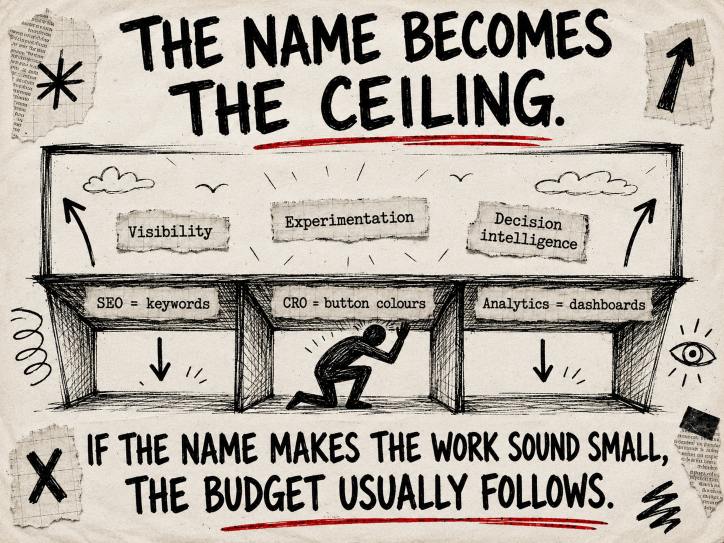
And a lot of digital ceilings are now way too low.
That is the bigger issue with legacy digital terms.
They do not just describe the work badly. They cause the work to be misunderstood.
And when work is misunderstood, it gets funded badly, staffed badly, measured badly, and judged badly.
Then everyone wonders why the results are average.
Again, Scooby-Doo would have solved this in twenty-two minutes.
The Work Is More Connected Than the Names Suggest
The other problem is that these terms create artificial silos.
SEO over here. CRO over there. Analytics somewhere else, quietly making charts no one reads properly.
But in reality, these functions should be deeply connected.
SEO brings qualified attention. CRO turns that attention into commercial value. Analytics explains what is happening and where to focus.
Separate them too much and you get dysfunction.
SEO drives traffic to pages that do not convert. CRO runs tests without understanding acquisition quality. Analytics reports numbers without influencing decisions.
Everyone is technically doing their job. The system is still broken.
The real opportunity is bringing these functions together. Not as disconnected digital tasks. As one commercial performance system.
Because the customer does not care what department owns the problem.
They do not care whether the issue sits in SEO, UX, CRO, analytics, product, content, pricing, operations, or development.
They just experience the business.
They search. They compare. They land. They judge. They hesitate. They decide. They buy, or they leave.
That journey does not care about your org chart.
Which is unfortunate, because org charts are often where good ideas go to die slowly while everyone asks who owns the action.
What We Should Probably Call Them Instead
I do not think these old terms are going away anytime soon.
SEO, CRO and analytics are too embedded. They are useful shorthand. They are searchable. They are understood enough to function.
But we should at least be honest about what they really mean now.
| Legacy term | What people often hear | What the work really is |
| SEO | Keywords and rankings | Organic visibility and demand capture |
| CRO | Conversion rate and button colours | Commercial experimentation and revenue leak repair |
| Analytics | Dashboards and reports | Decision intelligence and commercial diagnosis |
Are those terms perfect? No. Some of them sound like something invented in a conference room with bad coffee.
But they are closer to the actual work. And more importantly, they help senior people understand why these functions matter.
Because the goal is not to defend terminology.
The goal is to get the business to invest in the right things.
Better visibility. Better customer journeys. Better decisions. Better economics. Less waste. Fewer assumptions. More learning. More revenue from the attention you already fought hard to earn.
That is the work.
The names just need to catch up.
Sources
Sources used for the statistics and industry context referenced in the article:
- SparkToro – In 2026, Less than One Third of Google Searches Still Send a Click – https://sparktoro.com/blog/in-2026-less-than-one-third-of-google-searches-still-send-a-click/
- Search Engine Land – Google zero-click searches reach 68% in early 2026 – https://searchengineland.com/google-zero-click-searches-2026-study-479717
- arXiv – Measuring Google AI Overviews: Activation, Source Quality, Claim Fidelity, and Publisher Impact – https://arxiv.org/abs/2605.14021
- Shopify – How to Improve Ecommerce Conversion Rates – https://www.shopify.com/au/blog/ecommerce-conversion-rate
- Baymard Institute – Cart & Checkout Usability Research – https://baymard.com/research/checkout-usability
- Contentsquare – 2025 Digital Experience Benchmarks – https://contentsquare.com/press/2025-digital-experience-benchmarks/
- Contentsquare – 2026 Digital Experience Benchmark Report – https://contentsquare.com/guides/digital-experience-benchmark/
- IBM Think – What Is Data-Driven Decision-Making? – https://www.ibm.com/think/topics/data-driven-decision-making