An opinion on the 2026 Victorian election, political arrogance and the awkward business of listening to voters.
Good job, Victoria. We can postpone sawing you off the mainland.
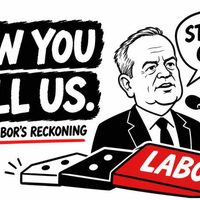
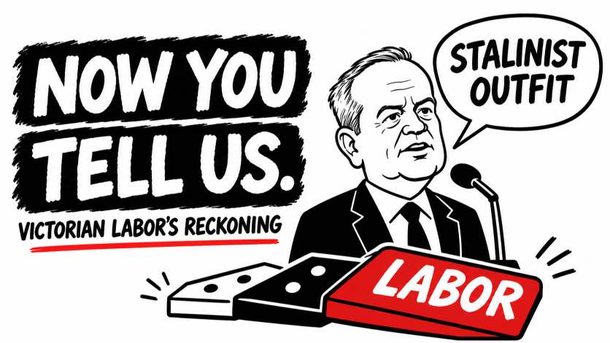
“Within Andrews Labor, to be honest, it became a pretty Stalinist outfit.”
Bill Shorten. Election night. Describing the culture inside his own party.
Wowsers.
You could spend weeks writing opposition advertisements and struggle to land something quite that brutal. Then a former federal Labor leader wanders onto the television and does the job for you.
The obvious question is when it became acceptable to say it.
After the election result? After the seats started falling? After the voters had done the uncomfortable work of removing the government?
If a party develops a culture where the leader cannot be challenged, the useful time to challenge it is while that leader still has power. Waiting until the electoral demolition crew arrives does make the observation somewhat less helpful.
Apparently, someone should have said something
There is something fascinating about the honesty that arrives after a political defeat.
Suddenly, people can identify the problems. They can explain the arrogance, the failure to listen and the distance between the party and the people it claims to represent.
Remarkable timing. The diagnosis becomes available just after the patient has been wheeled out.
Shorten’s description raises a question well beyond Daniel Andrews: what happens inside an organisation when disagreeing with the boss becomes more dangerous than letting the boss get it wrong?
People learn. They work out which concerns to soften, which questions to avoid and which decisions are already settled before the meeting begins. Eventually, agreement tells you very little. It might mean everyone supports the decision. It might mean everyone would like to remain employed.
That is how a party can keep reassuring itself while losing the confidence of the people outside it.
And elections have a lovely way of interrupting that arrangement. Voters don’t need a faction’s permission to disagree. They get a pencil.
The orange thank-you hamper
The Liberals should be sending Pauline Hanson a thank-you hamper. Preferably orange.
My view is that Labor still loses without One Nation. Whether the defeat reaches the same scale is another question.
We cannot rerun the election with one party removed, and preferences work differently from seat to seat. But One Nation gave dissatisfied voters another place to put their first preference. That matters when people are finished with Labor but aren’t ready to put the Liberals first.
Winning those voters outright and benefiting from their later preferences are different things. The Liberals would be wise to remember that.
A voter helping you remove a government hasn’t necessarily signed up for a lifetime membership.
For Wilson, the opportunity is obvious. So is the danger. Mistake relief at Labor’s departure for unconditional affection for the Liberal Party and you can start building the next defeat surprisingly quickly.
Melbourne looks left and orders another brunch
Meanwhile, the Greens made gains across former Labor territory, including Footscray, Northcote and Pascoe Vale.
Labor was losing people in different directions. Some wanted a government further to the right. Others wanted something further to the left. Treating that as one neat ideological verdict would be convenient, but it wouldn’t explain the result.
Still, Melbourne’s champagne socialist instinct remains a source of fascination to me.
Nothing says “down with capitalism” quite like discussing its inevitable collapse over a $32 brunch while checking what your investment property’s worth.
Yes, that’s a jab. The serious point underneath it is about consequences. It’s easy to embrace a policy in the abstract. The harder work is explaining who pays, what changes and what happens if it fails.
Being certain that your intentions are good doesn’t answer any of those questions.
With the upper house count still unfolding as I write, I’m hoping the eventual numbers keep the parties whose policies I most strongly oppose away from holding the deciding votes. That’s a preference, rather than a claim that the result is settled.
Changing the government loses some appeal if every decision still needs the same ideological permission slip.
Public safety shouldn’t need a political affiliation
One exchange on the ABC stayed with me: Patricia Karvelas questioning Labor deputy Gabrielle Williams about the party’s direction and its support on the left.
My reading of the discussion was that Labor’s tougher stance on crime had alienated some progressive voters. That’s my takeaway from the exchange, rather than a verbatim quote from Karvelas.
And my reaction was fairly simple: being tougher on crime is where you lose them?
I’d assumed wanting your house unburgled and your car still in the driveway was reasonably bipartisan.
People can disagree about sentencing, bail, prevention and rehabilitation. Those arguments matter. A policy should be judged by whether it reduces harm, rather than how tough someone looks announcing it at a press conference.
But public safety has to remain the objective. If a government starts taking crime seriously and part of its base regards that as an ideological betrayal, perhaps that part of the base needs challenging.
Working people have to live with the consequences. They don’t get to experience crime as an interesting disagreement on a panel show.
Prevention deserves attention. So do victims. Rehabilitation deserves investment. So does protecting people from someone who keeps offending.
None of that should require checking which team you’re on first.
I watched the ABC. Thoroughly enjoyed myself.
I watched the ABC’s election coverage for the first time in years. Thoroughly enjoyed myself.
There was a certain pleasure in watching the grovelling and the increasingly uncomfortable search for explanations. To my eye, some of the coverage carried the air of people trying to process a result they would rather not have received.
And geez, Raf Epstein. I found him a condescending wanker.
That’s my assessment of his manner. I can’t tell you what he privately thought about the result. But you can explain an election without leaving viewers feeling as though the electorate has disappointed you personally.
Journalists should challenge politicians. Hard. Including politicians I happen to agree with.
What irritates me is commentary that seems more interested in explaining what is wrong with voters than understanding what voters are rejecting.
The result doesn’t become less legitimate because the people delivering it aren’t using the language preferred by the panel.
Jess Wilson has earned a chance
And credit where it’s due: it’s good to see a strong woman leading from the front.
Jess Wilson is the first woman to lead a party to victory at a Victorian state election. Joan Kirner and Jacinta Allan served as premier before her, having taken over between elections. Wilson’s distinction is winning a state election as leader.
That is a milestone worth acknowledging.
Delivered by the centre right, too. Hopefully nobody needs to check her party membership before deciding whether female leadership counts as progress.
Do we celebrate, or wait for instructions?
I’m not sold on Wilson yet. Winning an election establishes that you can win an election. Governing well requires rather more.
She’s earned her chance. Now let’s see what she does with it. Better services, safer communities and responsible use of public money would be a useful start. A different face at the lectern won’t carry her indefinitely.
The useful time to listen is before you lose
The most revealing part of this election, for me, is how quickly people inside Labor could articulate what had gone wrong once the result was beyond saving.
That brings me back to Shorten’s line.
If the culture really had become that closed, then the failure went beyond one leader. It also involved everyone who saw the problem and decided challenging it could wait.
Wilson’s team should pay attention to that. Today’s fresh start can become tomorrow’s government insisting nobody understands how well it’s doing.
Voters can forgive mistakes. Being told their concerns don’t matter is a harder sell.
And if you’re waiting until election night to discover that your government stopped listening, here’s a suggestion:
Next time, say something before the voters have to remove the entire bloody outfit.