Why the next generation of websites will need a Human Experience on top and a Capability Layer underneath
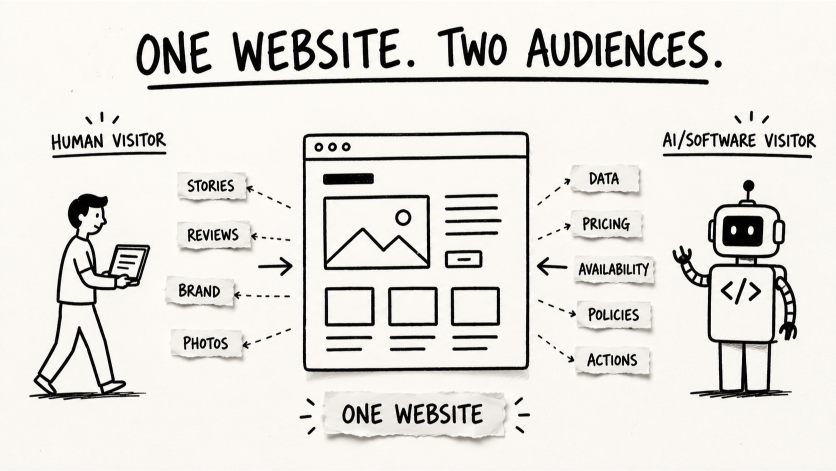
I keep wondering if we’re preparing websites for the wrong visitor.
For almost 30 years, we’ve designed websites around humans.
Humans searching.
Humans clicking.
Humans comparing.
Humans filling in forms.
We built navigation menus to help them find things. Landing pages to convince them. Filters to narrow their choices. Forms to capture their details. Checkout flows to finish the job.
The entire website assumes a person is sitting there, staring at a screen and patiently operating it.
But what happens when the visitor isn’t human?
What happens when your next customer sends an AI agent instead?
Not a chatbot sitting in the bottom-right corner of your website asking whether it can help.
An agent working for the customer.
One that researches the market, compares options, checks availability, reads the policies, calculates the real cost and returns with a shortlist.
The person may still make the final decision.
They just might not do the browsing themselves.
That idea still sounds slightly futuristic.
The data suggests it really isn’t.
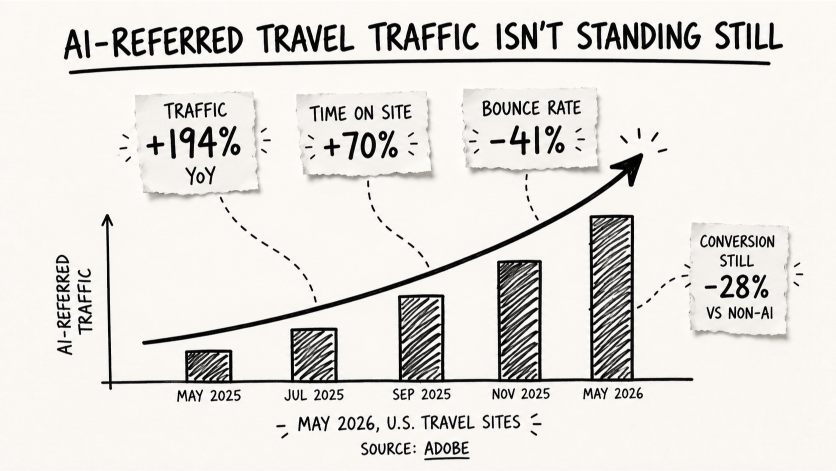
Adobe reported that traffic from AI sources to US travel websites grew 194% year on year in May 2026 and had increased 2,215% since it began tracking the channel in October 2024. Those visitors spent 70% longer on travel sites and were 41% less likely to bounce than visitors from traditional sources. They still converted 28% less often, but that gap had shrunk by almost 70% since October 2024.
That isn’t the death of traditional search.
It isn’t proof that everyone will hand their holiday planning over to a robot next Thursday.
But it is a pretty decent sign that a new kind of customer journey is forming.
The website roadmap probably needs to notice.
Websites currently assume one audience
Most modern websites have become a strange collection of jobs jammed into one interface.
They are:
- brand brochures;
- product catalogues;
- search engines;
- booking tools;
- help centres;
- policy libraries;
- account portals;
- sales funnels.
Yet every one of those jobs is wrapped inside a visual experience designed for humans.
The visitor is expected to understand your navigation.
They have to know that “Stay” contains accommodation, but “Experience” contains park facilities.
They have to open three tabs to compare products.
They have to discover that the pet policy is hiding in an FAQ, the cancellation terms are in a PDF and the actual price only appears after entering dates into a booking platform built during the Howard government.
We accept all of this because we have spent decades learning how websites work.
AI agents haven’t.
They do not care about your lovely mega-menu.
They want the facts underneath it.
| In many ways, the modern website is a database wearing a nice shirt. The shirt matters to people. The database matters to machines. |
The new visitor already exists
AI agents are different from the chatbots most businesses have spent the past few years slapping onto their websites.
A chatbot mainly talks.
An agent can use tools and take action.
OpenAI’s ChatGPT agent was launched with the ability to operate its own browser, conduct research, work with connected systems and complete tasks such as planning and booking offsites. OpenAI describes it as moving beyond answering questions into performing work, while also making clear that the technology remains early and can still make mistakes.
That distinction matters.
A traditional AI assistant might answer:
| Which holiday parks near the Gold Coast have a heated pool? |
An agent could eventually handle:
| Find me a two-bedroom cabin within three hours of Brisbane for four nights during the September school holidays. It needs a heated pool, activities for a six-year-old, decent cancellation terms and a total price under $1,800. |
The agent then has to:
- identify suitable providers;
- understand the properties and accommodation;
- check live availability;
- compare total prices;
- interpret policies;
- remove unsuitable options;
- present a recommendation;
- potentially complete the booking.
That is not really a search query.
It is a job.
And jobs require more than webpages.
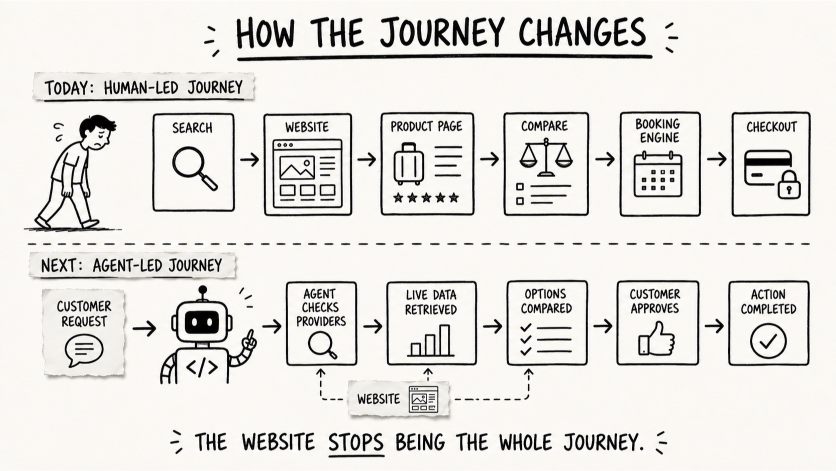
The website may stop being the journey
Today, a typical online journey looks something like this:
| Search engine → website → category page → product page → comparison → booking engine → checkout |
Every step assumes the customer is driving.
An agent-led journey looks different:
| Customer request → agent queries multiple providers → structured information is retrieved → suitable options are compared → customer approves → action is completed |
The agent may still visit webpages.
Current agents often use browsers because that is where the information lives.
But forcing software to operate visual interfaces designed for humans is hardly the final form.
It is the digital equivalent of hiring someone to copy numbers from one spreadsheet into another because the two systems refuse to speak to each other.
It works. Technically. But nobody should be proud of it.
The more useful long-term model is for businesses to expose their information and services in formats machines can understand directly.
That shift is already visible in the infrastructure being built around agents.
Anthropic’s Model Context Protocol (MCP) was created as an open standard for connecting AI applications with external data and tools. By December 2025, Anthropic reported more than 10,000 active public MCP servers and 97 million monthly downloads across its Python and TypeScript software kits. MCP had also been adopted by ChatGPT, Gemini, Microsoft Copilot, Cursor and Visual Studio Code.
Google launched its Agent2Agent protocol with support from more than 50 technology and services partners. A2A allows agents built by different companies to advertise what they can do, communicate and coordinate tasks across systems.
Then there is commerce.
Google and Shopify have co-developed the Universal Commerce Protocol, an open standard intended to let agents connect with merchants through common shopping and transaction capabilities. Shopify said in January 2026 that the protocol was already endorsed by more than 20 retailers and platforms.
The naming is still messy.
MCP. A2A. UCP. AP2.
Naturally, the technology industry saw a complicated shift coming and responded by creating enough acronyms to require another AI agent just to remember them.
But the direction is clear.
Agents are beginning to move from reading the web to using it.
A six-stage model for website readiness
There is no universally accepted maturity model for an agent-first website yet.
So this is my attempt to make the progression easier to understand.
Not a sacred industry framework.
Just a practical way to work out where your website currently sits and what probably comes next.
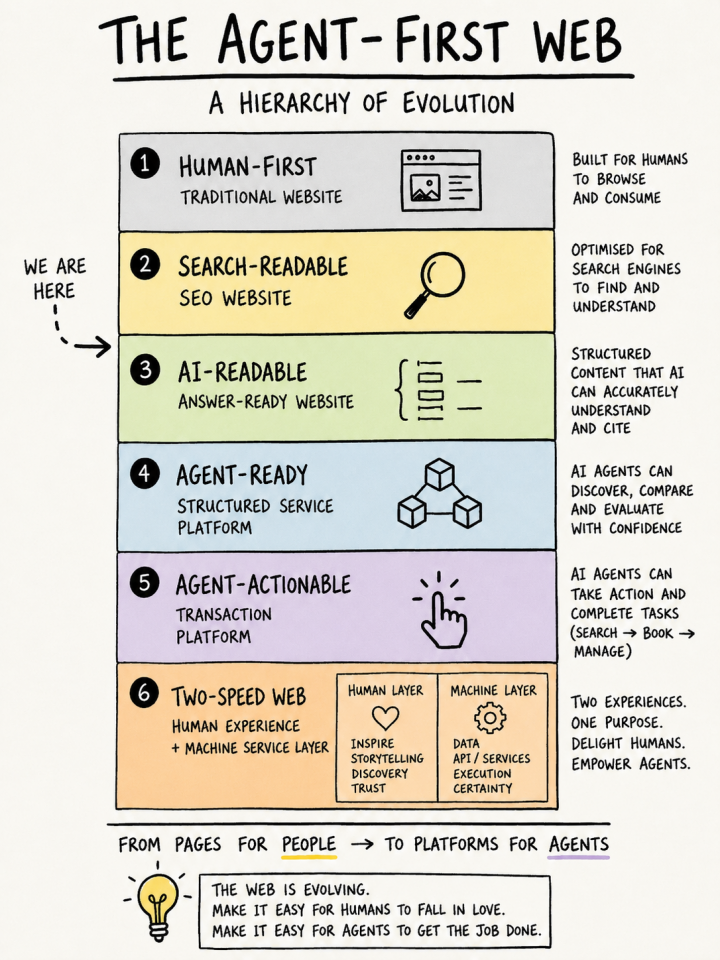
Stage 1: Human-first
The website is built almost entirely around a person operating it.
Information is spread across visual pages.
Important facts live inside marketing copy.
Navigation, filters and forms do the heavy lifting.
Machines may access the site, but that is incidental rather than designed.
Plenty of websites are still here.
They may look modern.
Underneath, they are basically brochures with forms attached.
Stage 2: Search-readable
The website becomes easier for search engines to crawl and understand.
This includes familiar SEO foundations:
- semantic HTML;
- descriptive page titles;
- logical URLs;
- internal links;
- canonical tags;
- XML sitemaps;
- indexable content;
- structured data.
Google describes structured data as a standardised way to provide explicit clues about the meaning and classification of content. Its published examples include Rotten Tomatoes recording a 25% higher click-through rate on pages enhanced with structured data and Food Network recording a 35% increase in visits after expanding its use.
This stage still matters enormously.
You do not leap from a messy, barely crawlable website into some magical agentic future.
The basics remain the basics.
Stage 3: AI-readable
This is roughly where stronger websites are moving now.
The objective is no longer only: “Can Google index this page?”
It becomes: “Can an AI system confidently extract and explain the correct answer?”
That requires much greater clarity.
| Instead of vague inspiration, machines need explicit facts: heated pool, beach distance, pet rules, accessibility, occupancy, check-in time and cancellation deadlines. |
The inspirational copy can stay.
But the facts need to exist separately from the fluff.
AI-readable websites have clear entities, explicit attributes, consistent policies and content that answers actual customer questions.
They stop making machines guess.
They should probably stop making humans guess too, but apparently we needed AI to arrive before that became urgent.
Stage 4: Agent-ready
An agent-ready platform exposes reliable information that software can retrieve and compare.
For a travel website, this might include:
- properties;
- accommodation types;
- locations;
- facilities;
- accessibility information;
- availability;
- pricing;
- inclusions;
- restrictions;
- cancellation terms;
- current offers.
The crucial difference is that this information does not exist only as words displayed on a page.
It exists as structured, reusable data.
Adobe’s June 2026 travel analysis gives us a useful glimpse of the current gap. It scored hotel homepages at 63% machine readability and hotel product pages at 73%. Even the leading travel category still had more than a quarter of important product content that machines could not properly access or interpret.
That is the uncomfortable bit.
A business can have excellent content and still be partially invisible to the systems increasingly helping customers make decisions.
Stage 5: Agent-actionable
At this stage, agents can do more than retrieve information.
They can use approved capabilities.
For example:
- check live availability;
- retrieve a confirmed price;
- place a temporary hold;
- create a booking;
- change a reservation;
- add an extra;
- submit an application;
- arrange delivery;
- cancel a service.
This is where a website stops being just an information source and becomes a service platform.
Commerce is moving quickly in this direction.
Shopify reported that AI-referred orders across its platform grew 13 times year on year in the first quarter of 2026. It also said AI-referred visitors converted at nearly 50% higher rates than organic-search visitors. Shopify’s advice to merchants is telling: use complete, literal, machine-readable product records rather than relying on agents to fill in the gaps.
That is the Capability Layer in action.
Not another landing page.
An actual service machines can use.
Stage 6: The two-speed web
This is where I think websites are heading.
One digital platform.
Two audiences.
A Human Experience built for inspiration, emotion, trust and exploration.
A Capability Layer built for accuracy, retrieval, comparison and action.
The website remains.
It simply stops pretending that every visitor needs the same interface.
What the two-speed web actually looks like
The phrase “two-speed web” is my framing rather than an agreed technical term.
But the mental model is useful.
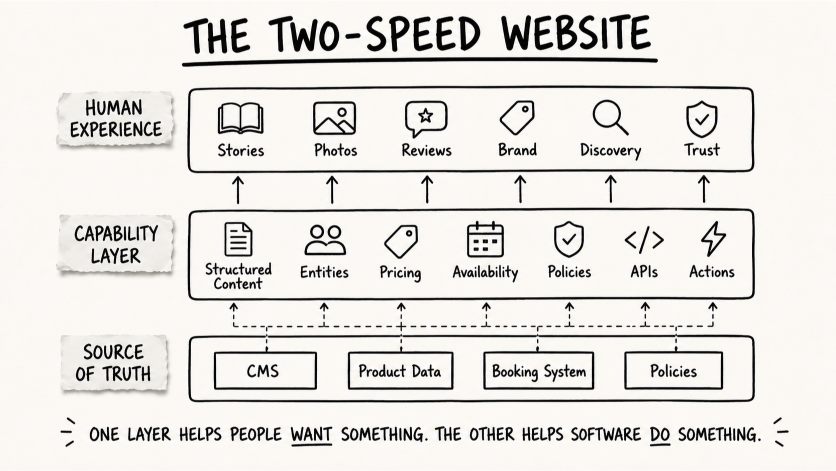
The Human Experience
The human-facing website is designed around the things people still care deeply about:
- stories;
- photography;
- personality;
- reassurance;
- reviews;
- brand;
- discovery;
- emotional confidence.
People want to know what the place feels like.
Is it relaxing?
Will the kids love it?
Does it look clean?
Does the company seem trustworthy?
Is this where we want to spend our money and our limited annual leave?
Those are not simply data questions.
They involve taste, emotion and context.
The human website still has plenty of work to do.
The Capability Layer
Underneath sits the information and functionality that software needs:
- structured entities;
- product and service data;
- relationships between entities;
- current prices;
- live inventory;
- eligibility rules;
- locations;
- policies;
- APIs;
- authentication;
- actions.
| One layer helps a person want something. The other helps software do something. |
That does not necessarily mean building two completely separate websites.
It means separating the underlying content and services from the visual interface used to present them.
Your website, mobile app, customer service tools, partners and AI agents should increasingly draw from the same trusted information.
Not five teams maintaining five slightly different versions of the pet policy and hoping nobody brings a Labrador over Christmas.
This is not just SEO with an AI sticker on it
There is an understandable temptation to treat agent readiness as the next branch of SEO.
Add more schema.
Create an llms.txt file.
Rewrite some FAQs.
Call it GEO, AEO, LLMO or whichever acronym wins the LinkedIn cage fight that week.
Those things may help.
But they do not create a Capability Layer.
SEO is largely concerned with whether a search engine can discover, understand and rank a page.
Agent readiness goes further.
It asks whether software can:
- understand what the business offers;
- determine whether it suits the customer;
- retrieve current information;
- compare it with alternatives;
- perform an approved action.
Structured data can tell a machine that a cabin exists and sleeps six people.
A capability can confirm whether that cabin is available next Saturday, calculate the total price and place it on hold.
That is a substantial difference.
| Schema helps the machine read the menu. The Capability Layer lets it order dinner. |
The website is only as ready as the business underneath it
This is where the conversation becomes less sexy.
No robot illustrations.
No futuristic interface mock-ups.
Just data governance.
Sorry.
Most businesses do not have an AI problem yet.
They have an information problem.
Their product details live in one platform.
Their pricing lives in another.
Policies sit in PDFs.
Opening hours are maintained manually.
Location information differs between the website and Google Business Profile.
The booking system uses different names from the CMS.
The contact centre has its own document containing the rules people actually follow.
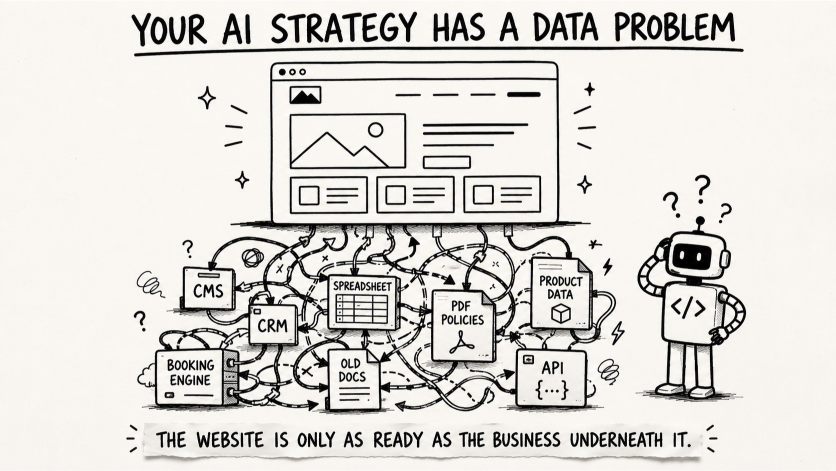
An AI agent cannot create certainty from organisational confusion.
It can merely discover the confusion faster.
The biggest work required for the two-speed web may have very little to do with AI models.
It may involve:
- agreeing on canonical entities;
- defining who owns each piece of information;
- consolidating duplicated data;
- improving API access;
- structuring content;
- connecting legacy systems;
- creating reliable update processes.
| AI agents will expose every bit of digital mess currently being held together by webpages and optimism. |
That is why this belongs on the roadmap now.
Not because every business needs autonomous transactions tomorrow.
Because fixing the foundations takes years.
What needs to go onto the roadmap?
Do not start by launching a giant “Agentic Web Transformation Program.”
That is how a useful idea ends up trapped in PowerPoint until 2029.
Start with boring, practical work that improves the website today and creates options for tomorrow.
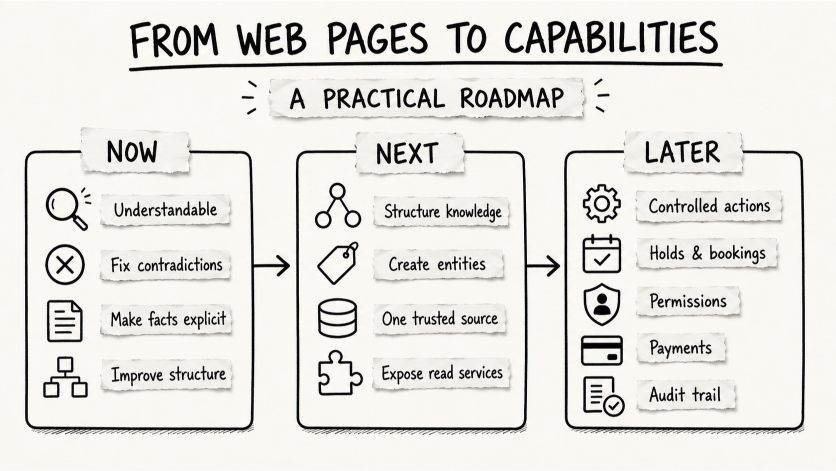
Phase 1: Make the website understandable
Begin by testing what machines can currently understand.
Create a set of real customer questions.
For example:
- Which products are suitable for families?
- Is this location accessible?
- Are pets allowed?
- What is included in the price?
- What happens if I cancel?
- Is there availability on specific dates?
- How far is it from the nearest airport?
- Can the service be changed after purchase?
Ask several major AI tools to answer those questions using your website.
Then check:
- Are the answers correct?
- Are they complete?
- Can the system identify the correct entity?
- Does it confuse different products or locations?
- Does it find outdated information?
- Does it cite the right page?
- Does it give up because the information is trapped in JavaScript or a booking engine?
This gives you an actual baseline.
Not a strategy workshop full of people nodding at the phrase “agentic experience.”
Phase 2: Structure the knowledge
Identify the information your customers and their agents need to make decisions.
Build structured models for things such as:
- products;
- services;
- properties;
- destinations;
- accommodation;
- amenities;
- events;
- offers;
- accessibility;
- policies;
- prices;
- availability.
Then define the relationships.
This property contains these accommodation types.
This cabin has these features.
This offer applies to these dates.
This cancellation rule belongs to this rate.
This activity is suitable for these ages.
This is entity architecture.
It sounds technical.
Really, it is just getting the business to agree on what things are and how they connect.
Harder than it sounds, obviously.
Phase 3: Create one trusted source
Every important operational fact needs a clear owner and a canonical source.
Not a webpage copied from a brochure copied from a spreadsheet copied from an email someone sent in 2021.
A trusted source.
The website should consume that information.
The app should consume that information.
The contact centre should consume that information.
Eventually, agents can consume that information.
This is the part that makes the whole model work.
Without it, you simply expose inconsistent rubbish more efficiently.
Phase 4: Expose read capabilities
Start with low-risk, read-only services.
Let approved systems retrieve things such as:
- product details;
- location information;
- policies;
- pricing;
- availability;
- opening hours;
- service eligibility;
- accessible options.
This may happen through existing APIs, new endpoints, feeds, commerce protocols or agent connectors.
The exact standard may change.
The underlying capability will not.
A customer needs to know whether something is available.
The format used to provide that answer is an implementation detail.
Phase 5: Introduce controlled actions
Only once the information layer is reliable should the business begin exposing actions.
Start carefully.
A sensible progression might be: Read information → retrieve live results → create a shortlist → hold inventory → request confirmation → complete transaction.
Every consequential action needs proper controls:
- identity;
- authentication;
- authorisation;
- customer confirmation;
- transaction limits;
- audit logs;
- fraud prevention;
- human escalation;
- rollback processes.
OpenAI’s agent documentation describes explicit confirmation before consequential actions and warns that agents browsing the open web can be vulnerable to prompt injection: hidden or malicious instructions designed to manipulate their behaviour.
The lesson is not “agents are too dangerous.”
The lesson is “do not hand an experimental robot the company credit card and wish it luck.”
Build the controls alongside the capability.
Not every AI visitor is valuable
There is another uncomfortable issue here.
AI systems do not always behave like search engines.
For years, website owners accepted search crawling because there was a fairly obvious exchange.
Search engines accessed the content.
Search engines sent visitors back.
AI changes that bargain.
The system may retrieve your information, answer the user directly and never send anyone to the site.
Cloudflare reported that in June 2025 OpenAI crawled pages about 1,700 times for each referral it sent, while Anthropic’s ratio was approximately 73,000 crawls per referral. Those figures reflect Cloudflare’s measured traffic and should not be treated as universal across every website, but they show how different the AI-content relationship can be from traditional search.
This means the agent strategy cannot simply be:
| Let every bot take everything and hope some traffic falls out. |
Businesses will need to make choices.
Which content should be easy to access?
Which information should require authentication?
Which capabilities should be public?
Which should be available only to trusted partners?
When should an agent be allowed to transact?
How does the business receive attribution or value?
The machine-facing web will need permissions and commercial rules, not just cleaner HTML.
Measurement will need to change too
Website analytics grew up around visits.
Someone arrived.
They viewed pages.
They clicked something.
They converted.
Agent-led journeys can remove much of that visible behaviour.
The customer might spend ten minutes talking to an AI assistant, compare five providers and arrive at your website only for the final step.
Or the agent might complete that step through an external interface.
The business still won.
The website session may barely exist.
That means digital teams will need to begin measuring things such as:
- AI referrals;
- citations and recommendations;
- agent queries;
- product-data retrieval;
- shortlist inclusion;
- API-originated leads;
- agent-assisted conversions;
- successful tool calls;
- failed requests;
- completed agent actions;
- revenue influenced by AI systems.
Adobe’s current data already shows why last-click thinking will struggle. AI-referred travel visitors are arriving with much higher engagement and lower bounce rates, suggesting considerable research has already happened before the website session begins.
The website is seeing the end of the conversation.
Not the whole conversation.
Does this mean websites disappear?
No.
I think the opposite could happen.
Websites may become more human.
Today, we ask the same interface to do everything.
It must inspire.
Explain.
Compare.
Search.
Validate.
Transact.
Support.
Educate.
Display legal terms.
Handle accounts.
Reset passwords.
Show a cinematic brand film and explain whether the swimming pool is heated.
No wonder websites become bloated.
A mature Capability Layer could take some of that operational burden away from the human experience.
The website can focus more sharply on the things people are good at appreciating:
- Stories.
- Design.
- Photography.
- Personality.
- Proof.
- Emotion.
- Trust.
The machine layer handles precision.
The human layer handles desire.
| The website does not disappear. It gets to stop pretending that one interface should do every job for every audience. |
The strategic risk of waiting
The risk is not that your website suddenly stops working.
That would almost be easier.
The risk is that it continues working perfectly well for humans while becoming difficult for agents to evaluate.
Your product exists.
Your service is available.
Your content is technically online.
But another provider is easier to understand.
Its product data is clearer.
Its policies are structured.
Its inventory is accessible.
Its pricing is current.
Its actions are available through trusted services.
So the agent recommends them instead.
The early web punished businesses that were not online.
Search punished websites that could not be discovered.
The agentic web may punish platforms that cannot be used.
Being present will not be enough.
You will need to be legible.
Eventually, you will need to be actionable.
One website. Two audiences.
Maybe we are not preparing websites for the wrong visitor.
Maybe we are preparing them for only one visitor.
Humans will continue to browse, explore and make decisions.
But software will increasingly work on their behalf.
That means the next generation of digital platforms will need two distinct strengths.
A Human Experience designed to inspire, persuade and build trust.
A Capability Layer designed to let machines understand, compare and act.
One website.
Two audiences.
The two-speed web is not here in its finished form.
The protocols are still developing.
The commercial models remain messy.
The agents still make mistakes.
But the direction is visible enough that digital leaders should begin making room for it now.
| Because the next visitor to your website may still be your customer. They might simply send something else first. |
Sources
1. Adobe report: AI traffic to travel sites soars nearly 200% as AI visitors now outperform traditional sources. Adobe Digital Insights, 17 June 2026. Source for AI-referred travel traffic, engagement, conversion and readability figures.
2. Introducing ChatGPT agent: bridging research and action. OpenAI, 17 July 2025. Source for browser-based agent capabilities, confirmations and security limitations.
3. Donating the Model Context Protocol and establishing the Agentic AI Foundation. Anthropic, 9 December 2025. Source for MCP adoption, public server and SDK download figures.
4. Announcing the Agent2Agent Protocol (A2A). Google Developers Blog, 9 April 2025. Source for A2A and its launch partner ecosystem.
5. Under the Hood: Universal Commerce Protocol (UCP). Google Developers Blog, 11 January 2026. Source for the design and purpose of UCP.
6. Shopify connects any merchant to every AI conversation. Shopify, 11 January 2026. Source for UCP co-development and endorsement by 20+ retailers and platforms.
7. Introduction to structured data markup in Google Search. Google Search Central, Current documentation. Source for structured-data guidance and the Rotten Tomatoes and Food Network examples.
8. Product Data Management in Ecommerce: An AI-Forward Guide. Shopify Enterprise, July 2026. Source for Q1 2026 AI-referred order growth and conversion-rate comparison.
9. Control content use for AI training with Cloudflare’s managed robots.txt and pay per crawl. Cloudflare, 1 July 2025. Source for the June 2025 crawl-to-referral ratios.