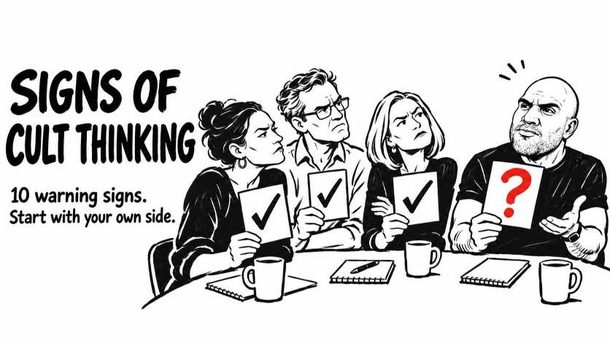
The clearest signs of cult thinking appear when questioning your group starts to feel like betraying it. Other warning signs include excusing the leader, dismissing outside information, treating critics as enemies and fearing what happens if you leave.
You can believe something strongly without handing over custody of your brain. The trouble starts when you can no longer tell the difference between defending an idea and protecting your place in the group.
Before you picture someone else, pick something you defend. Your politics. Your diet. Your favourite guru. The company whose founder apparently invented working hard.
Run the questions there first. Otherwise, this becomes another article about how everyone else is an idiot. We have plenty of those.
What is cult thinking, and when does it become undue influence?
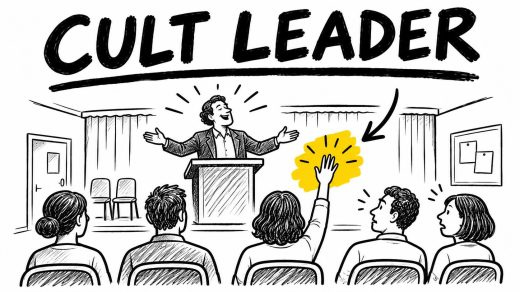
I use cult thinking to describe a pattern in which loyalty to a leader or group starts overriding your ability to question, check evidence and make independent decisions. That is a working description, rather than a clinical diagnosis.
It can appear in ordinary communities without making them equivalent to an abusive cult.
For a more specific definition of a cult, the Lalich Center describes groups organised around charismatic leadership, manipulation, coercion and a belief system that becomes difficult to challenge or escape.
Here, undue influence means pressure or manipulation that undermines a person’s independent judgement. Think of concealed demands, controlled information or threats to relationships, rather than someone simply making a convincing argument.
You might hear this described as mind control. Steven Hassan’s BITE Model of Authoritarian Control examines control over behaviour, information, thought and emotion. It offers a framework for examining influence, rather than a magic test that settles every disputed case.
The useful question is specific: What is happening to your freedom to think and choose?
10 warning signs of cult-like thinking
The following signs are prompts for examination. They are not a scoring system.
The International Cultic Studies Association explicitly cautions that its own list of cultic characteristics is an analytical tool, not a definitive checklist. Context, severity and the pattern over time matter.
1. Questions become evidence of disloyalty
You ask about a contradiction. Instead of getting an answer, you get an assessment of your character.
Why are you being negative? Who have you been listening to? Are you really committed?
The original question remains unanswered, which is convenient for everyone except the person who asked it.
ICSA identifies the discouragement or punishment of doubt and dissent as a characteristic of cultic environments.
Ask yourself: Can I challenge a meaningful claim without having to prove I am still a good person?
There is a difference between asking people to behave respectfully and demanding that they agree.
2. Cult leaders get exemptions from their own rules
Everyone else must be humble, transparent and accountable. The leader requires special arrangements.
Their extravagance is necessary. Their cruelty is misunderstood. Their failed prediction was a test of your faith, which seems an unusually generous interpretation of getting something wrong.
In my book, I examine the point at which defending a leader becomes more important than assessing their behaviour.
A useful test is to remove the name. Describe what happened as though an outsider did it. Would you still defend it?
Ask yourself: Am I evaluating the conduct, or working backwards from the conclusion that our leader must be right?
3. Information needs the group’s permission
You can read criticism, technically. You just have to accept that the journalist is corrupt, the researcher is compromised and the former cult member is unstable.
The group becomes your sole source of truth because every alternative has been disqualified before you examine it.
Hassan’s BITE framework specifically flags deception and conditioning people to distrust critics and former members.
You do not need to believe every accusation. You do need room to investigate one.
Ask yourself: Can outside evidence change my view, or must it first pass through the people being questioned?
A source can be unreliable. “They criticised us” is not sufficient evidence of that.

4. Slogans start doing your thinking
“Trust the process.”
“You’re still asleep.”
“That’s just your conditioning.”
Sometimes a phrase explains something. Sometimes it saves everyone the inconvenience of explaining anything.
Alexandra Stein’s recruitment warning signs include loaded language and repetitive phrases.
I recognise this habit in myself. In my book, I describe getting lazy with words such as “carnist” and “woke”. Different labels, similar temptation: put someone in a category and feel as though I had understood them.
Ask yourself: Can I explain my objection in ordinary language, without using a label my group already applauds?
If the argument disappears when you remove the catchphrase, you may have been defending a noise.
5. The outside world becomes one enormous enemy
An us vs them mentality turns complicated people into two convenient piles.
We are awake. They are sheep. We care. They are cruel. We understand reality. The rest of society has apparently misplaced it.
ICSA includes polarised thinking and claims of special status among the characteristics associated with cultic groups.
Being told you are one of the chosen can feel lovely. It also makes disagreement remarkably easy to dismiss.
Ask yourself: Can I describe a decent, informed person who disagrees with us?
You can oppose someone’s position without needing them to be defective. If that distinction has become impossible, examine what your group rewards.
6. Attention and affection depend on agreement
When you arrive, you are fascinating. Finally, people understand you.
Then you question something. The warmth drops. People become concerned about your attitude. The invitations slow down. Agreement restores the atmosphere.
Stein flags extreme or inappropriate early friendliness as a recruitment warning sign. Friendliness alone proves nothing; watch what happens when you establish a boundary.
The pattern I explore in my book is affection becoming conditional on compliance.
Ask yourself: Do these people care about me when I am inconvenient?
Try imagining that you decline the next purchase, donation or commitment. Does the relationship still make sense?
7. Your life outside the group keeps shrinking
There is always another event, call, course or urgent contribution. Your old friendships become awkward to maintain. Eventually, almost everyone you speak to shares the same explanations.
Stein identifies isolation, excessive involvement and pressure to cut ties with family or friends among her warning signs.
You do not have to move into a compound to lose contact with the outside world. Look at who you still speak to freely.
Ask yourself: Who outside the group knows what my life is actually like?
Choosing distance from an abusive relative is different from being pressured to cut ties because someone questions the group.
8. Former followers are always wrong
One person leaves: bitter.
Several leave: coordinated attack.
A detailed account appears: attention seeking.
“Former followers are always wrong” is an extraordinarily helpful rule for anyone hoping to avoid scrutiny. It means the people with direct experience become less credible precisely when they stop agreeing.
This is the distrust of former members highlighted in Hassan’s framework.
Ask yourself: What would a credible criticism from a former member look like?
People can misremember, exaggerate or lie. That applies inside the group too. Assess specific claims and available evidence rather than granting either side automatic innocence.
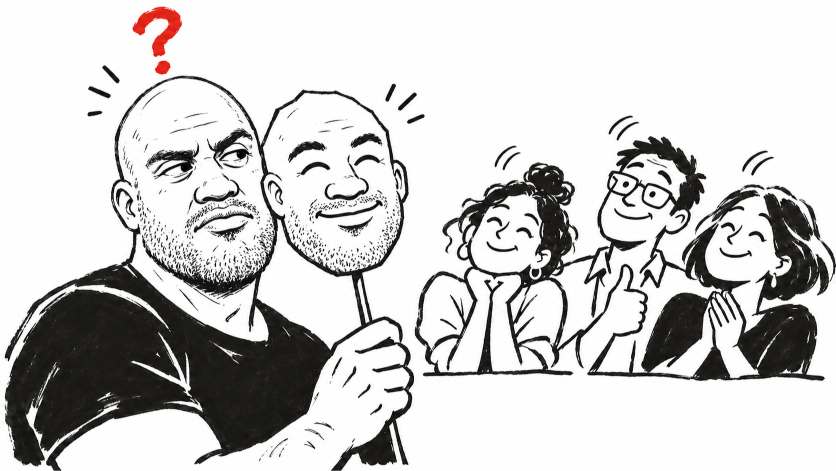
9. You have a public opinion and a private one
You hear yourself agreeing while privately thinking, “That isn’t true.”
Occasional tact is ordinary life. Nobody needs your unfiltered commentary throughout a wedding.
Persistent self-censorship is different. You rehearse acceptable answers. Hide reasonable questions. Laugh at something you found cruel because silence might be noticed.
I write about this gap in my book: the growing distance between what you think and what you feel able to say.
Ask yourself: What sentence do I keep deleting before I say it?
Then ask what you expect would happen if someone heard it. The answer may reveal more than another hour studying the group’s public values.
10. Leaving feels forbidden, dangerous or morally unthinkable
Missing people is understandable. Losing a routine can hurt. Neither proves you are trapped in a cult.
Examine the consequences being attached to leaving the group. Will people shun you? Are you threatened with exposure, retaliation or catastrophe? Does wanting to leave supposedly prove that you are corrupt?
Ask yourself: Can someone leave with their dignity and relationships intact?
If you fear retaliation, you do not need to announce a departure just to test the answer. Seek confidential support first.
Why intelligent people join a cult
Intelligence does not remove the need for belonging, purpose or reassurance.
Janja Lalich’s bounded choice framework examines how charismatic authority, an overarching belief system, control and social influence can combine to restrict the choices people perceive as available.
Within that setting, a decision that looks baffling from outside can feel consistent with everything a person understands about their world.
People join a group for reasons that can make sense: friendship, spiritual meaning, political change, help with a problem. The full demands may not be apparent at the beginning.
Reducing this to “vulnerable people fall for things” also lets everyone else relax too quickly. Vulnerability can be situational. Wanting connection with others is hardly an exotic personality flaw.
A better question than “How could intelligent people believe that?” is: What made questioning it costly?
Does a charismatic leader or religious group make something a cult?
A charismatic leader can inspire worthwhile work. A religious group can have demanding practices and still respect its members’ choices.
Unusual beliefs, enthusiasm and commitment do not settle the issue.
Stein’s account of cult dynamics focuses on control, isolation and exploitation. Her examples extend beyond religion.
So assess the arrangements. Who can challenge the authoritarian leader? Can members maintain outside relationships? Are expectations disclosed? Can consent be withdrawn?
A community might have cult-like characteristics without operating as a fully coercive system. Equally, a group with respectable branding can behave abusively.
Calling everything you dislike a cult makes the word less useful. Describe the psychological manipulation or coercive control you can actually identify.
A cult-thinking audit to use on yourself
In my book, You’re in a Cult, I explore how belonging, language and identity can make our own blind spots surprisingly comfortable.
The book uses “cult” broadly and metaphorically when examining everyday tribes. That does not equate an irritating fandom with an abusive high-control group.
Its Cult Audit asks seven questions:
- What does this give me?
- What does it ask from me?
- Who am I allowed to question?
- What am I not allowed to say?
- Who becomes the enemy?
- What would it cost me to leave?
- Who would I be if I stopped needing this to be true?
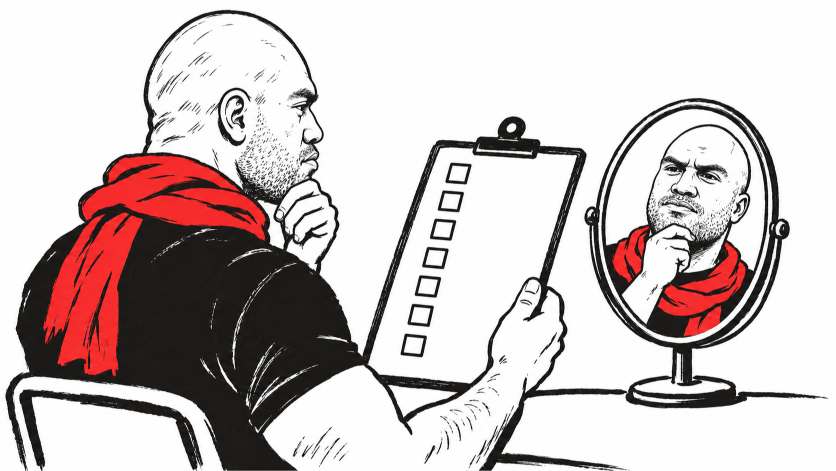
These are reflection questions, not a diagnostic test.
Start with the belief you defend fastest. Explain its strongest criticism fairly. Notice where you become evasive. You may keep the belief after examining it. Ideally, you will understand why.
How to leave a cult or help someone you know
If several warning signs describe your situation, start with a private conversation with someone outside the group’s influence. You do not need to win an argument about the word “cult” before discussing behaviour that concerns you.
If you fear consequences involving your safety, housing, money or children, seek confidential advice before confronting the leader or group. A departure may need practical preparation.
For someone already outside, cult recovery can involve rebuilding relationships and making sense of experiences. Stein recommends support from a therapist or group that understands how cults operate. A mental health professional with relevant experience may help.
If you are worried about someone you know, resist turning every conversation into a prosecution.
In Rachel Bernstein’s guidance for families, published by ICSA, she recommends listening, avoiding arguments and keeping a route back to connection open.
Ask concrete questions: “What happens if you disagree?” or “Can you take a break?” Leave room for an honest answer.
Australians can also find information through Cult Information and Family Support.
Questions about recognising the signs of a cult
Can cult thinking happen without a formal cult?
Yes, in the broad sense used here. Treating disagreement as betrayal or repeating a group’s explanations without examining them can occur in everyday settings. Those habits alone do not establish that an organisation is a cult.
What is the difference between commitment and cult-like behaviour?
Look at how consent and disagreement work. Someone can choose a demanding commitment while retaining outside relationships and independent judgement. Concealed demands, manipulation and punishment for questioning deserve closer examination.
Are these signs you’re in a cult?
They are reasons to investigate your situation, rather than a verdict. Examine specific conduct, its severity and your freedom to refuse. You can seek help with harmful behaviour without first proving which label applies.
Keep the question pointed at yourself
Recognising the signs of a cult is easy when the people involved already annoy you.
The harder work begins with the belief that makes you feel intelligent. The leader you instinctively defend. The group whose approval you would hate to lose.
Keep whatever survives honest examination. There is no prize for abandoning a sound idea just to look independent.
Your favourite belief can stay. It just doesn’t get diplomatic immunity.