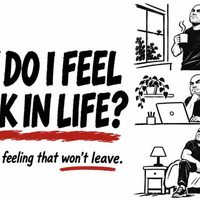
I feel stuck in life, and I don’t know why I can’t shake it.
I wake up thinking about it. It turns up in the middle of the day. I go to bed and it’s still there. Same question. No useful answer.
Why do I feel stuck in life?
There isn’t one obvious disaster I can point to. No single thing that explains why this feeling has made itself so comfortable. It’s just there, refusing to fucking leave.
The closest I can get to an explanation is that I’m doing plenty, but I’m unsure whether it adds up to the future I want. Work gets done. Ideas get explored. Things get made. The bigger question keeps coming back.
That might be part of it. I don’t know whether it’s the whole thing.
I’m writing this from inside the feeling, while I’m still trying to understand it.
Why I feel stuck in life even when things look fine
I’m 47. I have a wife, two kids, a home and a senior role in digital and marketing. I’ve worked across technology, tourism, festivals and entertainment. I’ve published a book. I’m writing more.
There’s a lot in that life worth keeping.
Which makes the feeling difficult to explain. You can list the good things, acknowledge every one of them, and still have a question sitting underneath the list.
Is this how I want the next ten years to look?
I can’t answer that by pointing at my CV. The CV tells me what I’ve done and what someone might pay me to do next. It’s less helpful on the subject of what I actually want my days to feel like.
It has never once asked whether I’d like fewer meetings. Rude, considering how much effort I’ve put into it.
I can value what I have and want something in my life to change. The difficulty is getting specific about that something. Saying “I feel stuck” describes the experience. It doesn’t tell me where to put the spanner.
Doing plenty and still feeling like I’m not getting anywhere
I’ve looked at different jobs. Different careers. Businesses to buy. Businesses to build. Consulting. Products. Content platforms. Ways to work from somewhere else.
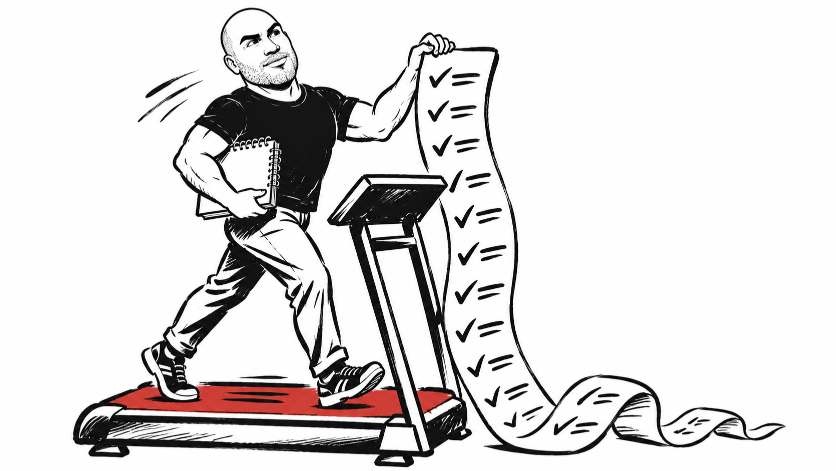
Meanwhile, I’m working, writing, publishing and learning.
There is movement. Actual movement. A published book is a real thing, regardless of what mood I’m in when I look at it.
So I have to be careful with the story I tell myself. “I’m getting nowhere” ignores things I’ve finished. It also fails to explain why finishing them hasn’t settled the larger question.
Maybe I’m expecting individual achievements to answer a question about the shape of my life. Publish this. Build that. Find a better role. Surely one of them will produce the feeling that I’m finally heading somewhere I’ve chosen.
They might help. They might also be worthwhile things that don’t carry an answer to everything else.
That distinction matters when the obvious advice is to start taking action. I’m already taking action. I’m trying to work out which actions connect to the change I’m looking for.
Another full week doesn’t make that clear by itself.
Making decisions when every possible future has bills
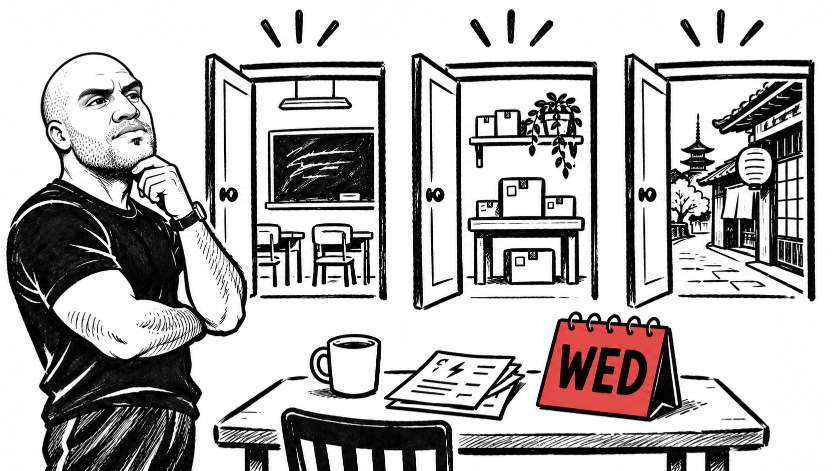
I explored teaching. Business studies and ICT were possibilities. There was a scholarship pathway, then a barrier to getting a course place, followed by the question of whether I could justify the fees.
That was a possible change meeting an actual obstacle.
I’ve looked at buying a business, too. Something I could improve using the skills I’ve spent years developing. Then I get into the practical questions: what does it earn, what does it cost, and how much of me does it need every week?
If the income depends on my constant presence, I need to understand what freedom I’m actually buying.
Building something raises different questions. Can it grow beyond my own hours? Is there a genuine problem to solve? Will someone pay for the solution? Can I build it alongside the job that currently pays the bills?
Every possible future eventually has to explain how it pays for an ordinary Wednesday.
This is where “just take the leap” starts to sound a bit thin. I have people I love whose lives are connected to my decisions. Taking risks means something different when the consequences are shared.
I want to protect what matters to us. I also want to know whether I’m being sensible about a particular risk or asking for so much certainty that I’ll never choose anything.
I can’t assume every rejected idea is procrastination. Some ideas deserve to be rejected. But I can ask whether the research is helping me make decisions, or whether I’m collecting possible futures without getting closer to choosing one.
That’s an uncomfortable question. Probably more useful than opening another tab.
Is this burnout, or do I want a different life?
I’ve described feeling overwhelmed and anxious about work before. That belongs in the picture.
The World Health Organization describes burnout as an occupational phenomenon linked to chronic workplace stress that hasn’t been successfully managed. Its definition covers exhaustion, growing distance or cynicism towards the job, and reduced professional efficacy. It specifically concerns work.
That gives the word some boundaries. It isn’t a diagnosis I can apply to every uncomfortable thought about my future.
The question I keep coming back to is this: if my current job became easier, would I want to keep doing it?
I don’t have a settled answer. But it seems worth separating the demands of the job from the longer-term question of direction.
A new project could interest me and still add to an already crowded week. A rest could give me breathing room and leave the career question waiting when I return.
Before I commit myself to another ambitious solution, I want to understand what problem I’m asking it to solve.
One life, and a question I can’t neatly explain
My dad died recently.
I don’t know how much of this feeling connects to losing him. Questions about work, money and the future were already there. I don’t want to take his death and turn it into a tidy explanation for all of them.
Healthdirect’s guidance on grief describes how differently people can experience loss, including effects on energy, concentration and sleep. That leaves room for more than one response, rather than an expectation that grief should look a particular way.
For me, the honest thing is to acknowledge that the loss is part of my life while I’m asking these questions. How it fits is something I’m still working out.
I’m 47. I have one life. I’d like to make deliberate choices about the years ahead, without turning the fact that time is passing into another reason to panic about every decision.
There’s enough pressure in trying to choose a future. I don’t need to make every ordinary day a referendum on whether I’m wasting my existence.
What am I asking money and Japan to change?
I’ve put a number on financial freedom. A substantial one.
Money matters here. It pays for choices, absorbs mistakes and changes what a household can afford to consider. Pretending it’s irrelevant would be ridiculous.
But I need to ask what I expect to be different once I have enough of it. Which decisions would become possible? What would I stop doing? What would I keep doing because I actually wanted to?
Otherwise, I can build an extremely detailed financial target around a very vague picture of the life it’s supposed to fund.
Japan is more specific. I’ve explored the possibility of living there with my family, including schooling, income and remote work. I’ve looked at whether six months might be possible, as well as a longer move.
It’s a place I want to experience more deeply. There are things about everyday life there that appeal to me, including consideration in public spaces, service and order.
Still, the useful picture includes an ordinary working Tuesday. The kids need schooling. Work needs doing. Bills still arrive. I’d like to understand which parts of the change come from the place and which require a different way of organising our lives.
It would be an expensive way to discover I’d brought the same unresolved question with me, along with four suitcases.
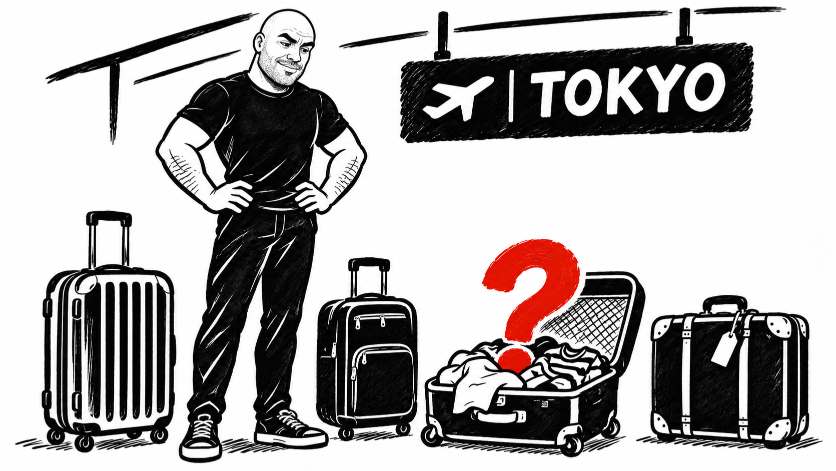
I want to give the idea a fair chance by being honest about what I’m asking of it.
Feeling lost or stuck doesn’t explain how much effort is going in
Words like “unmotivated” and “directionless” don’t quite describe my situation.
I can get interested in plenty of things. I can put work into them. What feels unclear is which direction deserves a bigger commitment, and how that commitment fits with everything else I value.
That leaves me suspicious of advice that treats the feeling of being stuck as proof I need to squeeze more output from myself.
In my book, You’re in a Cult, I examine how productivity can become an identity, with routines and systems turning into measures of personal worth. The tools can help. The trouble starts when your life has to answer to them.
Writing about that doesn’t make me immune to the appeal. A system is an attractive proposition when you want a sense of control over your life.
But I need to leave room for the possibility that another system won’t answer this particular question. I can organise the week beautifully and still be unsure what I want it to contain.
I also want to keep some things because they matter in their own right. Writing can be worth doing before it proves itself as a scalable business. A family experience can matter without helping me reach a financial target.
If everything has to become a route out, I risk asking too much of the things I might otherwise enjoy.
Frequently asked questions about feeling stuck in life
Why do I feel stuck in life even though I’m achieving things?
Achievements show that something has been accomplished. They don’t automatically establish that the wider direction suits you. In my case, I’m trying to understand why real progress in work and writing coexists with uncertainty about the future. I don’t think dismissing those achievements helps me answer that.
Does feeling stuck mean something is wrong with me?
The phrase alone doesn’t establish what’s causing the feeling. Calling it a personal failure doesn’t explain much either. It’s worth looking at what you’re experiencing, how long it’s been happening and what needs attention. Pressure at work, external circumstances, life transitions and health concerns deserve consideration on their own terms.
When should I talk to a mental health professional?
You can seek support because the feeling is persistent or distressing; you don’t need to wait for a crisis. If it affects daily functioning, or comes with ongoing low mood, hopelessness, lost enjoyment or sleep changes, speak with a GP or mental health professional. Healthdirect recommends seeking help when symptoms of depression have been present for two weeks or more. Feeling stuck by itself doesn’t establish depression.
Finding direction while the answer is still unclear
I’d love to finish this with the thing that fixed it.
It would make an excellent final section. Very satisfying. Possibly a downloadable worksheet.
I haven’t got it.
What I have are some questions I want to get more precise about:
- Which parts of my current life do I want to carry forward?
- What would have to change in an ordinary week for the future to feel different?
- What could I test on a manageable scale before making a bigger commitment?
Those questions might help me choose small steps that tell me something. A test of a business idea. A clearer account of the work I’d like to do. A serious look at what a period overseas would involve.
They’re possibilities I’m considering, rather than a routine I can claim has already worked.
I still wake up with the feeling. I still think about it during the day. Writing this hasn’t made it disappear, and I won’t pretend that putting a heading above it has solved it.
But “why do I feel stuck in life?” is too important a question to keep answering with a longer to-do list.